

How to Make French Press Coffee: A Guide to the Perfect Brew
How to make French press coffee is beautifully simple: combine coarse coffee grounds with hot water (around 200°F), let it steep for four minutes, then slowly press the plunger down. That's it. But mastering this immersion technique unlocks a rich, full-bodied cup that your standard drip machine just can’t touch.
Why the French Press Delivers Unbeatable Flavor
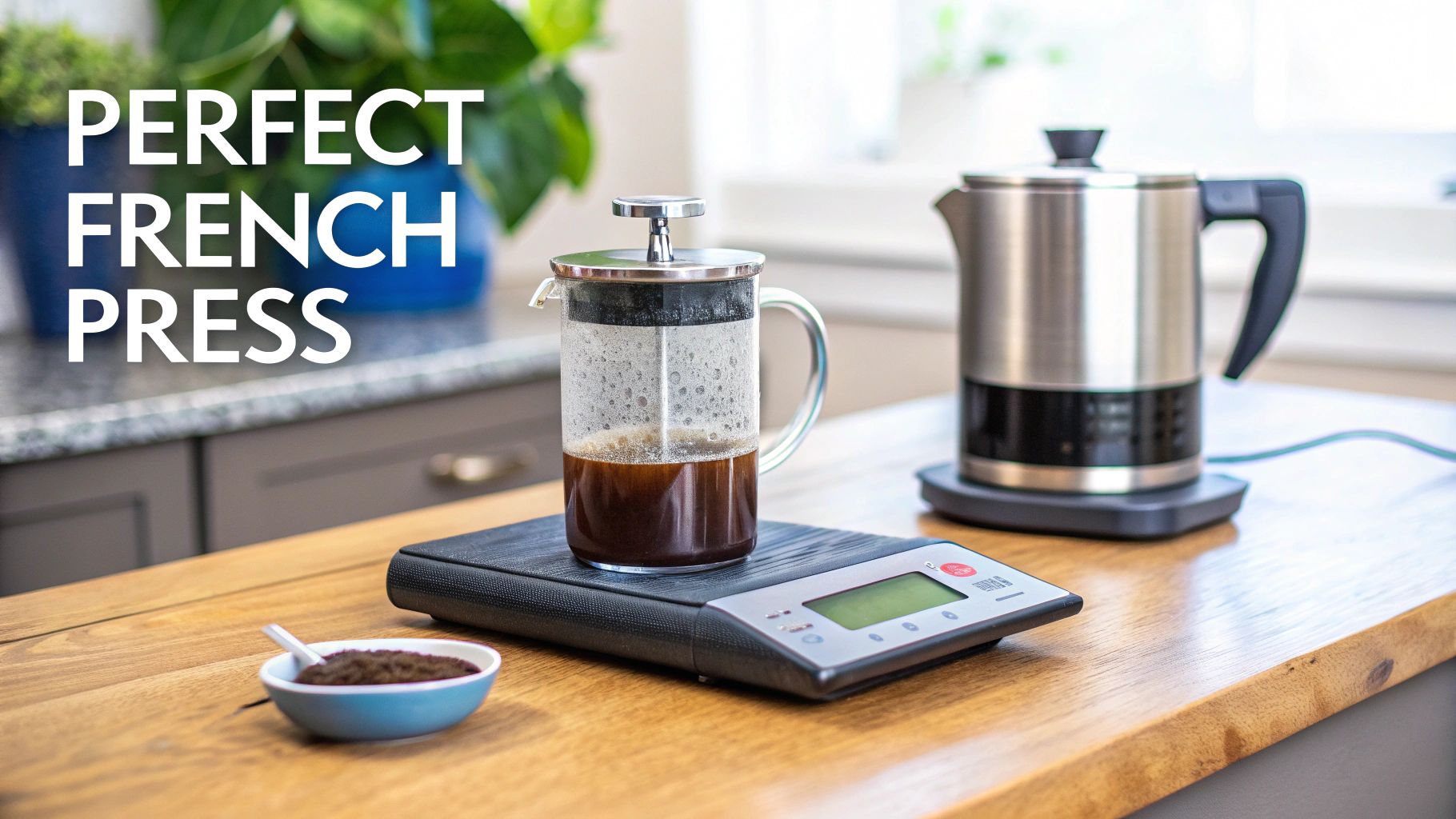
Forget complicated machinery and paper filters that strip away precious flavors. The French press is celebrated for its straightforward, hands-on approach and the incredible depth it brings to your morning ritual.
By fully immersing the coffee grounds in hot water, this method coaxes out a higher concentration of the natural oils and soluble solids that give coffee its soul. This direct contact is what creates that signature full-bodied, almost velvety texture coffee lovers are always chasing.
Unlike pour-over or drip methods, a French press uses a metal mesh filter. This is key. It allows all those aromatic oils and even some microscopic coffee particles (we call them fines) to pass right into your cup. The result? A brew that feels heavier, richer, and far more robust on your palate.
The Art of Immersion Brewing
The real beauty of the French press is the control it gives you. You're not just pushing a button and walking away; you're an active participant in crafting your coffee. From the grind size to the final plunge, every element is in your hands.
This hands-on process allows you to:
- Dial in your perfect strength by tweaking the coffee-to-water ratio.
- Fine-tune the flavor profile by playing with steep times.
- Experience the true character of your favorite beans without a paper filter getting in the way.
This level of control is a huge reason for its enduring popularity. The French press, invented by Attilio Calimani way back in 1923, has become a cornerstone of the specialty coffee movement. Its market value has surged to over US$904.6 million globally, driven by enthusiasts who appreciate the ritual just as much as the results. You can learn more about the French press market growth and its manual brewing appeal.
A common myth is that French press coffee is always bitter. Not true. Bitterness is almost always a sign of over-extraction, which is an easy fix—just coarsen your grind or shorten your steep time.
A Ritual Worth Savoring
Beyond the technical stuff, learning how to make French press coffee is about embracing a more mindful brewing experience. It encourages you to slow down, engage your senses, and appreciate the transformation from dry grounds to a fragrant, delicious drink.
It’s a simple, rewarding ritual that connects you more deeply with the coffee you love, turning a daily habit into a moment of genuine enjoyment.
Assembling Your French Press Brewing Kit
Before you can nail down how to make the perfect French press coffee, you need the right gear. Think of it less like a shopping list and more like building a toolkit for a rewarding morning ritual. Every single piece plays a part in the final cup you get to enjoy.
The heart of your setup is, of course, the French press itself. They come in a few different materials, and each one brings something different to the table. Glass carafes are the classic choice—they look great and let you watch the magic happen—but they do lose heat a bit quicker. Stainless steel models are built like tanks, offering incredible durability and keeping your coffee hotter for way longer. Ceramic presses also hold heat really well and just feel substantial on the countertop.
If you're just getting started, a solid glass model like the OXO 8-Cup French Press with its handy Grounds Lifter is a fantastic choice. It makes the dreaded cleanup a total breeze and serves as a perfect gateway into the world of immersion brewing.
The Grinder and Kettle: Your Keys to Flavor
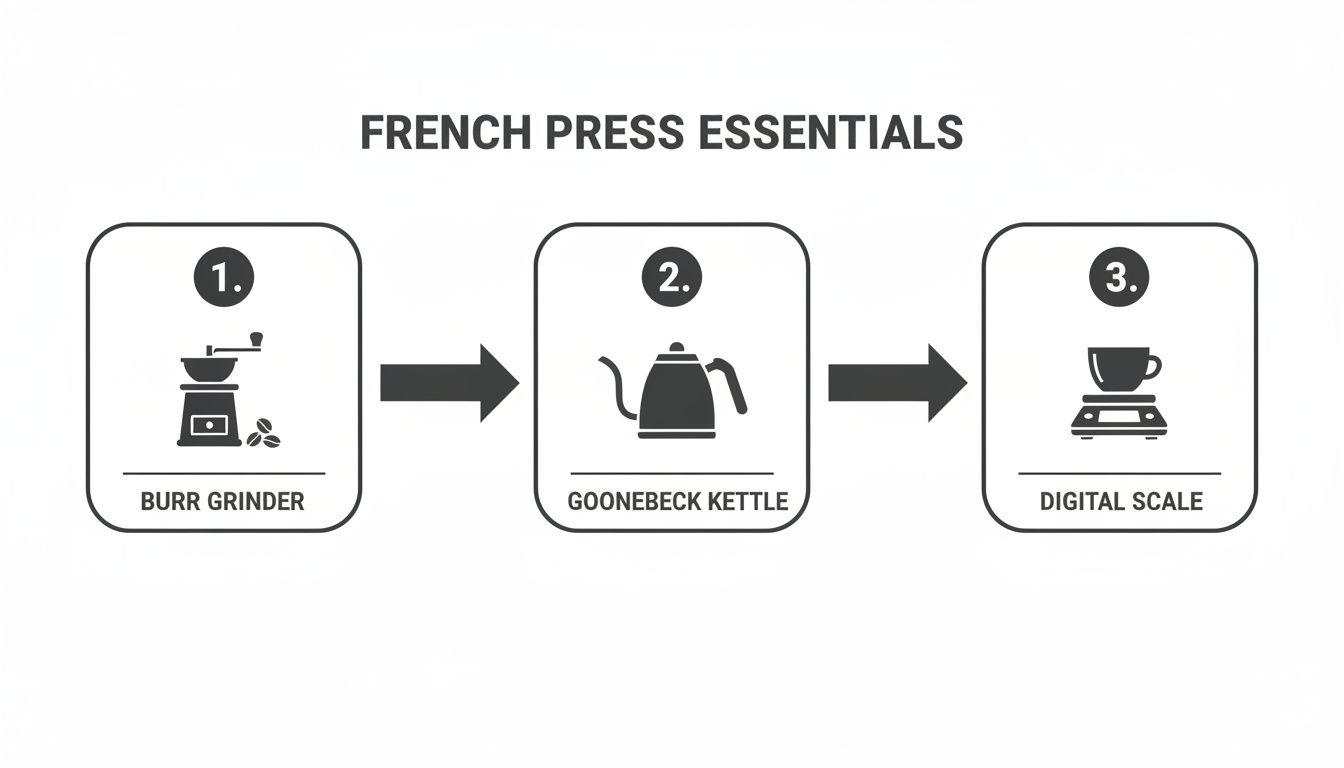
After the press, the single most important tool in your arsenal is a quality coffee grinder. I know pre-ground coffee is convenient, but it's almost always ground too fine for a French press, which is a one-way ticket to a silty, bitter brew. A burr grinder is absolutely non-negotiable here. It crushes beans into a consistent, uniform size, unlike blade grinders that just create a chaotic mix of dust and boulders.
Why is consistency so important? For a French press, you're aiming for a coarse grind, something that looks and feels like coarse sea salt. This specific size allows for an even extraction over the four-minute steep, preventing the harsh bitterness that comes from pulling too much out of those tiny, fine particles.
Your water source is just as critical. A gooseneck kettle gives you incredible control, letting you pour gently and evenly over the grounds. Many of them even have built-in temperature control, which is a total game-changer for hitting that perfect 195-205°F sweet spot. Water that’s boiling hot will scald the coffee, and water that’s too cool will just give you a weak, sour, and under-extracted cup.
Precision Tools for Repeatable Success
To truly ditch the guesswork and get cafe-quality results every single time, you need two final items: a digital scale and a timer. Brewing by weight, not by volume, is the real secret to consistency. A scoop can be wildly different each time, but a gram is always a gram.
Using a digital scale lets you lock in your ideal coffee-to-water ratio. That precision means once you find a recipe you love, you can hit it perfectly, day in and day out. A simple timer—whether it's on your phone or built into your scale—ensures you don’t accidentally over or under-steep your brew.
Key Takeaway: A burr grinder and a digital scale are the two most significant upgrades you can make to your brewing setup. They move you from guessing to knowing, transforming your coffee from good to consistently great.
To make things even easier, here’s a quick-glance table of your essential kit.
Essential French Press Equipment and Its Purpose
This simple reference guide breaks down the must-have tools for brewing French press coffee and explains why each one is so crucial for unlocking the best possible flavor.
| Tool | Recommended Type | Why It's Important |
|---|---|---|
| French Press | Glass, Stainless, or Ceramic | Your brewing vessel. Material affects heat retention and durability. |
| Coffee Grinder | Burr Grinder | Creates a consistent, coarse grind essential for avoiding silt and bitterness. |
| Kettle | Gooseneck with Temp Control | Heats water precisely to 195-205°F and provides pouring control. |
| Digital Scale | Any kitchen scale | Ensures a perfect coffee-to-water ratio for repeatable results. |
| Timer | Phone or separate timer | Tracks the 4-minute steep time to prevent over-extraction. |
Once you have these tools lined up, you’re in complete control. You've got everything you need to start your journey toward mastering the timeless art of the French press.
Mastering Your Ratios and Technique
Alright, you've got your gear ready to go. Now for the fun part—turning those beans into an incredible cup of coffee. This is where we move past the basic instructions and get into the details that make a real difference, transforming your morning routine into a ritual you’ll actually look forward to.
The absolute foundation of a great French press is the coffee-to-water ratio. While everyone’s taste is a little different, the specialty coffee world has a go-to starting point: a 1:15 ratio. All this means is for every one gram of coffee, you'll use 15 grams of water. It's the sweet spot for getting all the good stuff out of the beans without the coffee tasting weak or way too strong.
For a big, satisfying mug, that usually looks like 30 grams of coarse coffee and 450 grams of water. No scale? You're looking at roughly four heaping tablespoons of coffee to about 16 ounces of water. But honestly, if you want to nail it every single time, weighing your ingredients is a total game-changer. A tool like the Rocket Miniplus Coffee Scale, which has a built-in timer and ratio calculator, takes all the guesswork out of it.
Setting the Stage
Before the coffee even touches the water, two quick prep steps will seriously upgrade your brew.
First, preheat your French press. Just pour a bit of hot water into the empty carafe, give it a swirl for 30 seconds, and dump it out. This stops the cold glass from dropping your brew temperature, keeping everything nice and stable while it steeps.
Next, get that water temperature right. The perfect zone for a French press is between 195°F and 205°F. Boiling water (212°F) is a no-go—it’ll literally scorch the grounds and leave you with a bitter, burnt taste. If you don't have a fancy temperature-control kettle, no worries. Just bring the water to a boil, take it off the heat, and let it hang out for about 45 to 60 seconds. That's all it takes to cool down to the ideal temperature.
The Bloom, The Steep, and The Stir
Now for the best part. Add your coarsely ground coffee to your warm press.
Start your timer and pour in just enough water to wet all the grounds—about double the weight of the coffee. So, for 30 grams of coffee, pour in about 60 grams of water. Do it in a slow circle to make sure everything gets saturated.
You'll see the coffee grounds puff up and bubble. This is called the "bloom," and it's a beautiful sight. Freshly roasted coffee has trapped CO2, and this first pour lets it all escape. Giving it 30 seconds to bloom means those gases won't get in the way of a clean, even extraction.
Once it's bloomed, give it a quick, gentle stir with a wooden spoon (metal can chip or crack a glass press). Now pour in the rest of your water, pop the lid on with the plunger pulled all the way up, and let the magic happen.
Your greatest tool for flavor control is the steep time. Four minutes is the gold standard. It's just enough time to pull out all the complex flavors without getting into bitter territory. If you like it extra bold, you can push it to five minutes, but I wouldn't go much longer than that.
The Final Plunge
When that four-minute timer dings, it's time to press. This part is more art than science. Whatever you do, don't just slam the plunger down.
Go for a slow, steady, 30-second plunge. Pushing too fast stirs up all the fine particles (the "silt") at the bottom, forcing them through the filter and right into your cup. That’s what gives you that gritty, sludgy last sip. A slow press keeps those fines settled, giving you a much cleaner cup.
Once it's pressed, serve it immediately. Don't let the coffee sit in the press, or it'll keep extracting from the grounds at the bottom and turn bitter. Pour it all out into your mug or another carafe to stop the brewing process cold and lock in that perfect flavor.
How Different Roasts Affect Your Final Cup
Getting the mechanics of your French press down is half the battle. The other, more exciting half? Picking the right beans. The French press is a master at revealing a coffee's true soul, and nothing defines that soul more than its roast level.
Because the metal filter lets all the natural oils and fine coffee particles into your cup, you get a raw, unfiltered taste of where the bean came from and how the roaster shaped it. This means your choice of bean is the single biggest factor determining whether your cup is bright and zesty or deep and chocolatey.
Think of it like a spectrum. Light roasts hang onto the bean's delicate, original flavors. Dark roasts, on the other hand, develop bold, smoky notes from the roasting process itself. Your personal taste will point you toward the perfect bag for your morning ritual.
The Brightness of Light Roasts
If you love a cup that pops with life and has a clean, crisp finish, light roasts are where the party's at. These beans are only roasted until the "first crack," a moment when they audibly pop and expand. This gentle touch preserves all the unique flavors tied to the coffee’s origin—its soil, climate, and elevation.
When you brew a light roast in a French press, here's what you can expect:
- Higher Acidity: Not sour, but a pleasant brightness, like the tartness of a green apple or a squeeze of citrus. It makes the coffee feel incredibly refreshing.
- Fruity and Floral Notes: You’ll find yourself tasting things like blueberry, strawberry, lemon, or even jasmine. These subtle flavors are the star of the show.
- Lighter Body: The coffee will feel less heavy in your mouth compared to its darker-roasted cousins.
For anyone curious to dive into this world, our collection of vibrant light roast coffees is the perfect starting point. They're a fantastic way to see just how diverse and exciting coffee can be, especially on a sunny morning.
Fun fact: It's a common myth that light roasts are weak on caffeine. Measured by weight, they actually have slightly more caffeine than dark roasts because the beans are denser.
The Balanced Comfort of Medium Roasts
Medium roasts are the ultimate crowd-pleasers. They strike that perfect balance between a bean’s inherent flavors and the delicious notes developed during roasting. Pulled from the roaster somewhere between the first and second crack, these beans offer a fuller body and a smooth, well-rounded profile.
A medium roast in your French press delivers a cup that’s both familiar and intriguing. You’ll find comforting flavors like caramel, milk chocolate, roasted nuts, and brown sugar. The acidity is toned down, and the body is satisfyingly smooth without being heavy. It’s the perfect go-to coffee—reliable, delicious, and just plain comforting.
The Bold Richness of Dark Roasts
For those who want their coffee to be a powerful, intense experience, dark roasts deliver. Roasted to the "second crack" or even a little beyond, these beans are oily, dark, and pack a serious flavor punch. The roasting process caramelizes the sugars and brings natural oils to the surface, creating a bold profile that pairs beautifully with milk and sugar.
When you use a dark roast for French press, you'll get:
- A Heavy, Syrupy Body: This is that classic, rich texture that French press is famous for.
- Deep, Roasty Flavors: Think dark chocolate, burnt caramel, smoke, and maybe a hint of spice.
- Low Acidity: All the bright, sharp notes have been roasted away, leaving a smooth, bittersweet finish.
Honestly, the French press is one of the best ways to brew a dark roast. It perfectly captures that inherent boldness and rich body, giving you a cup that’s intense, satisfying, and hard to forget.
French Press Flavor Profiles by Roast Level
The roast level is your roadmap to flavor. This quick guide shows what you can generally expect from light, medium, and dark roasts when you brew them in a French press.
| Roast Level | Expected Tasting Notes | Body and Acidity |
|---|---|---|
| Light | Bright, fruity, floral (citrus, berry, jasmine) | Lighter body, high acidity |
| Medium | Balanced, sweet (caramel, milk chocolate, nuts) | Medium body, moderate acidity |
| Dark | Bold, roasty, rich (dark chocolate, smoky, spice) | Heavy body, low acidity |
Ultimately, the "best" roast is completely up to you. Don't be afraid to experiment with different beans to discover which profiles you love the most. The French press is a forgiving and expressive brewer, making it the perfect tool for your coffee journey.
Fixing Common French Press Brewing Issues
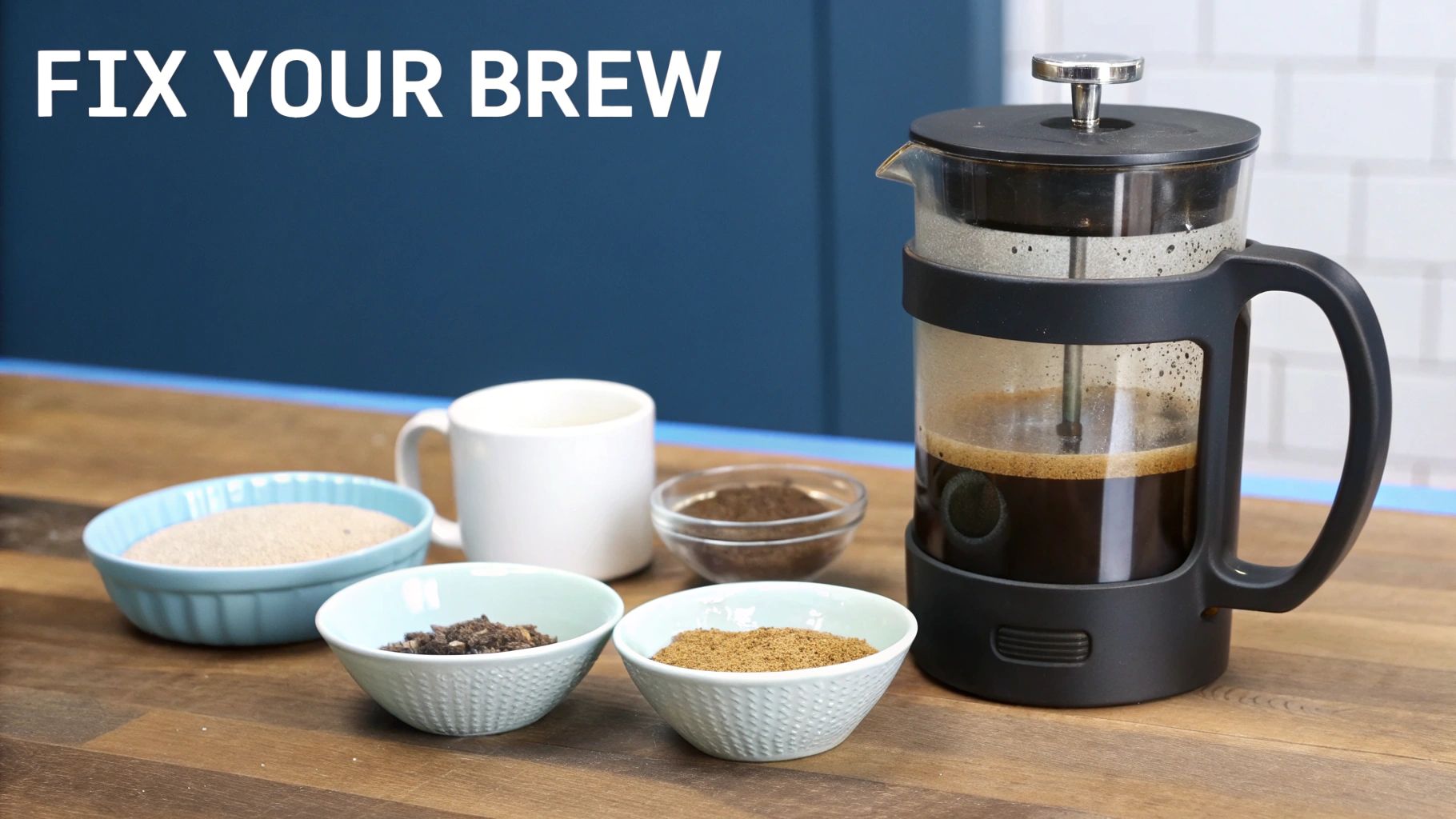
Even when you follow every step perfectly, you can still end up with a cup that just doesn't hit the mark. It happens to the best of us. Think of this section as your personal brewing troubleshooter—a guide to diagnosing the issue so you can make small, smart adjustments for a fantastic result every time.
Most brewing problems really just boil down to a few key variables. Once you understand how they influence the final taste, you'll gain the confidence to tweak your technique on the fly, turning a frustrating brew into a learning experience.
Why Does My Coffee Taste Weak and Watery?
A thin, lifeless, or sour cup is almost always a sign of under-extraction. All that means is the water didn't have enough time or contact to pull all the good stuff—the oils and flavors—from the coffee grounds. Fortunately, this is one of the easiest issues to fix.
First, take a look at your grind size. If your grounds are too coarse, looking more like small pebbles than chunky salt, the water just flows right past without grabbing enough flavor. Try adjusting your burr grinder a click or two finer to increase the surface area.
Next, consider your coffee-to-water ratio. A weak brew might just be a simple case of not using enough coffee. If you're using a 1:16 or 1:17 ratio, try strengthening it to our 1:15 golden ratio (that’s 30g of coffee to 450g of water) for a much richer, more satisfying body.
Finally, your water temperature could be too low. If it's below 195°F, it just won't have the energy to properly dissolve everything. Make sure your water is just off the boil, right around 200°F, to give it the power it needs for a full extraction.
Quick Fix for Weak Coffee The fastest and most effective adjustment is to simply make your grind a little finer. This single change often resolves weakness without needing to mess with your ratio or temperature.
Why Is My Coffee So Bitter?
On the other end of the spectrum is that harsh, unpleasant bitterness that coats your tongue. This is a classic symptom of over-extraction, where the water has pulled too much out of the grounds, including all the bitter compounds.
The most common culprit here is a grind that’s too fine. If your coffee grounds look like sand or table salt instead of coarse sea salt, they’ll extract way too quickly. A fine grind can also clog the filter, making the plunge feel tough and stirring up extra sediment. Go a few notches coarser on your grinder.
Your steep time is another major factor. A standard four-minute brew is perfect for a coarse grind, but if your coffee tastes bitter, try cutting that back to three or three-and-a-half minutes. Seriously, even 30 seconds can make a massive difference in taming that harshness.
A less common, but still possible, cause is water that's just too hot. Water at a rolling boil (212°F) can literally scald the grounds, creating a burnt, bitter flavor. Let your kettle rest for about a minute after boiling to bring the temperature down into that sweet spot of 195–205°F.
How Do I Deal with Sludge in My Cup?
Finding a layer of silt at the bottom of your mug is a signature trait of the French press, but you can definitely minimize it for a cleaner cup. Too much sediment is usually caused by two things: an inconsistent grind or a poor plunging technique.
Here are a few tips to get a cleaner brew:
- Improve Your Grind Consistency: A quality burr grinder is non-negotiable here. Blade grinders create a mix of dust and boulders, and all that coffee dust will sail right through the mesh filter.
- Press Slowly and Gently: Don't rush the plunge. A slow, steady 30-second press is ideal. Pushing down hard and fast creates turbulence that forces fine particles around the sides of the filter and into your coffee.
- Don't Plunge All the Way: Stop just before the plunger hits the compacted bed of grounds. Squeezing it all the way down will force out bitter oils and fine particles you don't want in your cup.
- Pour with Care: After plunging, pour the coffee into your mug or a separate carafe slowly and steadily. If you tilt the press too quickly, you'll agitate the sediment at the bottom and send it right into your cup.
By troubleshooting these common issues, you're not just fixing a bad cup of coffee—you're mastering the craft of brewing.
Your French Press Questions, Answered
Even the most seasoned coffee lover runs into a question or two. This is where we tackle those common head-scratchers that pop up when you're dialing in your French press technique. Think of it as your personal cheat sheet for troubleshooting and perfecting your brew.
Can I Just Use Pre-Ground Coffee?
You can, but I wouldn't recommend it if you're chasing that truly amazing cup. The problem is that almost all pre-ground coffee is milled for automatic drip machines, which means it’s way too fine for a French press.
When the grind is too fine, two things happen. First, a ton of those tiny particles will sneak right through the mesh filter, leaving you with a mouthful of sludge. Second, that fine grind over-extracts like crazy during the four-minute steep, pulling out all the harsh, bitter flavors you want to avoid. It’s a recipe for a muddy, disappointing brew.
The Single Biggest Upgrade: If you do just one thing, make it this: switch to whole beans and grind them fresh, right before you brew. Aim for a coarse grind that looks like rough sea salt. This simple move unlocks a universe of flavor and aroma that pre-ground coffee just can’t touch.
How Do I Keep My French Press Clean?
A clean press is non-negotiable for good coffee. Leftover coffee oils turn rancid fast, and they'll make your next brew taste stale and just plain off. A little daily maintenance and a weekly deep clean make all the difference.
For your daily rinse:
- As soon as you're done pouring, scoop out the grounds (a small spatula helps).
- Give the carafe and plunger a good rinse with hot water.
- Let everything air dry completely before reassembling.
Once a week, or whenever it starts looking oily, give it a proper scrub:
- Take it apart. Unscrew the bottom of the plunger to separate the mesh screen and metal plates.
- Give it a good wash. A little dish soap, warm water, and a soft sponge will cut through most of the grime.
- Banish stubborn buildup. For tough stains, a paste of baking soda and water works like a charm. It’s abrasive enough to clean without scratching the glass or steel.
- Rinse and dry, seriously. Make sure every single piece is totally dry before you put it back together. This stops mildew in its tracks and ensures a tight seal for your next brew.
Why Do I Have to Pour All the Coffee Out at Once?
This is a classic rookie mistake, and it can tank an otherwise perfect brew. Pushing the plunger down doesn't stop the coffee from brewing. Those grounds are still sitting at the bottom, steeping in hot water, and they will keep on extracting.
If you let the coffee sit in the press, it will get stronger, more bitter, and harsher with every minute that passes. That beautifully balanced cup you nailed at the four-minute mark will be long gone.
To lock in that perfect flavor, you have to decant the entire batch immediately. Pour every last drop into your mugs or a separate thermal carafe right after you press. This separates the coffee from the grounds, hitting the brakes on the extraction process. It’s a simple habit that guarantees your second cup tastes just as incredible as the first.
Ready to put your newfound knowledge to the test with beans that truly shine in a French press? Lost Without Coffee Co. offers a curated selection of ethically sourced, freshly roasted coffee perfect for your next outdoor adventure or quiet morning at home. Find your new favorite brew today.
Article created using Outrank