

Why Does My Coffee Taste Bitter and How to Fix It
Alright, let's fix that bitter coffee for good. The short answer to your problem is over-extraction. You're essentially pulling too much of the wrong stuff out of your coffee grounds.
Think of it like steeping a tea bag for way too long. What starts out pleasant and flavorful quickly turns harsh, astringent, and, well... bitter. This usually boils down to three common culprits: your brew time is too long, your water is too hot, or your coffee grounds are too fine.
Your Quick Guide to Fixing Bitter Coffee
If you've ever grimaced after that first morning sip, you're definitely not alone. In fact, some surveys show that roughly 35–40% of people brewing coffee at home list bitterness as their main complaint, and it’s almost always tied to simple brewing mistakes. The good news? You have complete control over this. Want to dig deeper? You can find out more about coffee market trends and see just how common these issues are.
Bitterness is the very last flavor to be pulled from coffee grounds during brewing. Your goal is to stop the process before those harsh compounds take over the cup.
There’s a sweet spot for a perfectly balanced brew, what we call the "ideal extraction yield." This is when you've dissolved 18–22% of the coffee's soluble compounds. Push past that range, and you start pulling out those intensely bitter elements you're trying to avoid.
This section gives you a clear, actionable table to diagnose the problem right away. Use it as a quick checklist to figure out what's going wrong in your routine and apply an instant fix. Your coffee tomorrow morning will thank you.
Common Causes of Bitter Coffee and How to Fix Them
Use this quick-reference table to diagnose and solve the root cause of your bitter coffee. Think of each variable as a lever you can pull to adjust the final taste, turning a bitter brew into something you'll actually enjoy.
| The Problem | Why It Causes Bitterness | The Quick Fix |
|---|---|---|
| Grind is Too Fine | A fine grind (like powder) creates way more surface area, causing water to extract flavors too quickly and pull out bitter compounds. | Use a coarser grind setting. For drip coffee, aim for the consistency of table salt; for French press, think coarse sea salt. |
| Brew Time is Too Long | Leaving coffee grounds in contact with hot water for too long is the classic definition of over-extraction. | Reduce your total brew time. If you're using a French press, plunge sooner. For a pour-over, pour the water a bit faster. |
| Water is Too Hot | Water above 205°F (96°C) essentially "burns" the grounds, scalding them and extracting bitter flavors aggressively. | Let your kettle sit for 30-60 seconds after it boils before you pour. The ideal temperature range is between 195-205°F. |
Each of these adjustments is small, but they make a massive difference in the final cup. By paying attention to these three factors, you're well on your way to a consistently balanced and delicious brew.
Understanding the Science of Coffee Extraction
To really nail your brew every time, you’ve got to get a handle on what’s actually happening when hot water meets coffee grounds. Think of it like making a really good soup stock. You simmer everything just long enough to pull out those rich, savory flavors. But if you let it boil for hours on end, the stock turns murky, harsh, and, you guessed it—bitter. Brewing coffee is pretty much the same game.
That whole process of water dissolving flavors from your coffee grounds? That's called extraction. It’s not an on/off switch; it’s a process that happens in predictable stages. All the good stuff that makes coffee taste amazing doesn't all come out at once.
The Order of Flavor Extraction
Picture a flavor timeline. As soon as water hits the coffee, it starts dissolving the compounds that are easiest to grab. These are the flavors that give coffee its bright, lively personality.
-
First to Arrive (The Bright and Sweet): Fruity acids and simple sugars are the first ones out of the gate. They’re super soluble and lightweight, giving you those initial bright, clean notes you find in a perfectly brewed cup.
-
Next Up (The Body and Balance): As the brew continues, oils and caramels start to join the party. These are heavier compounds that build the coffee's body, its mouthfeel, and those balanced, rounded flavors. This is the sweet spot—where most great coffee lives.
-
Last to the Party (The Bitter and Heavy): Finally, if you let it keep going, the least soluble compounds—think plant fibers and phenols—begin to break down. These are intensely bitter and astringent. When you brew for too long, use water that's way too hot, or grind your beans into dust, you're just inviting these unwanted flavors into your cup.
The key takeaway is this: bitterness isn't some random flaw. It’s a predictable result of letting the extraction run too long and pulling out that final layer of heavy, harsh-tasting compounds. Your job as the brewer is to stop the process before that happens.
Over-Extraction and Under-Extraction
This staged process is exactly why you can end up with coffee that’s either "under-extracted" or "over-extracted." Each one is just a sign that something in your brewing process is out of balance.
An under-extracted coffee tastes sour, thin, and weak. This happens because you stopped the brew too early. You only managed to pull out those initial bright acids without giving the balancing sweetness and body a chance to show up.
On the flip side, a coffee that is over-extracted tastes bitter and hollow. This is our main culprit. It happens when the brew goes on for too long, dissolving not just all the good stuff but an overdose of those final-stage bitter compounds. This is the big "why" behind your bitter coffee.
Once you realize you're the one in control of this timeline, you gain the power to make a consistently delicious cup. You're not just guessing anymore; you're becoming a more intuitive and confident brewer.
How Your Brewing Method Affects Bitterness
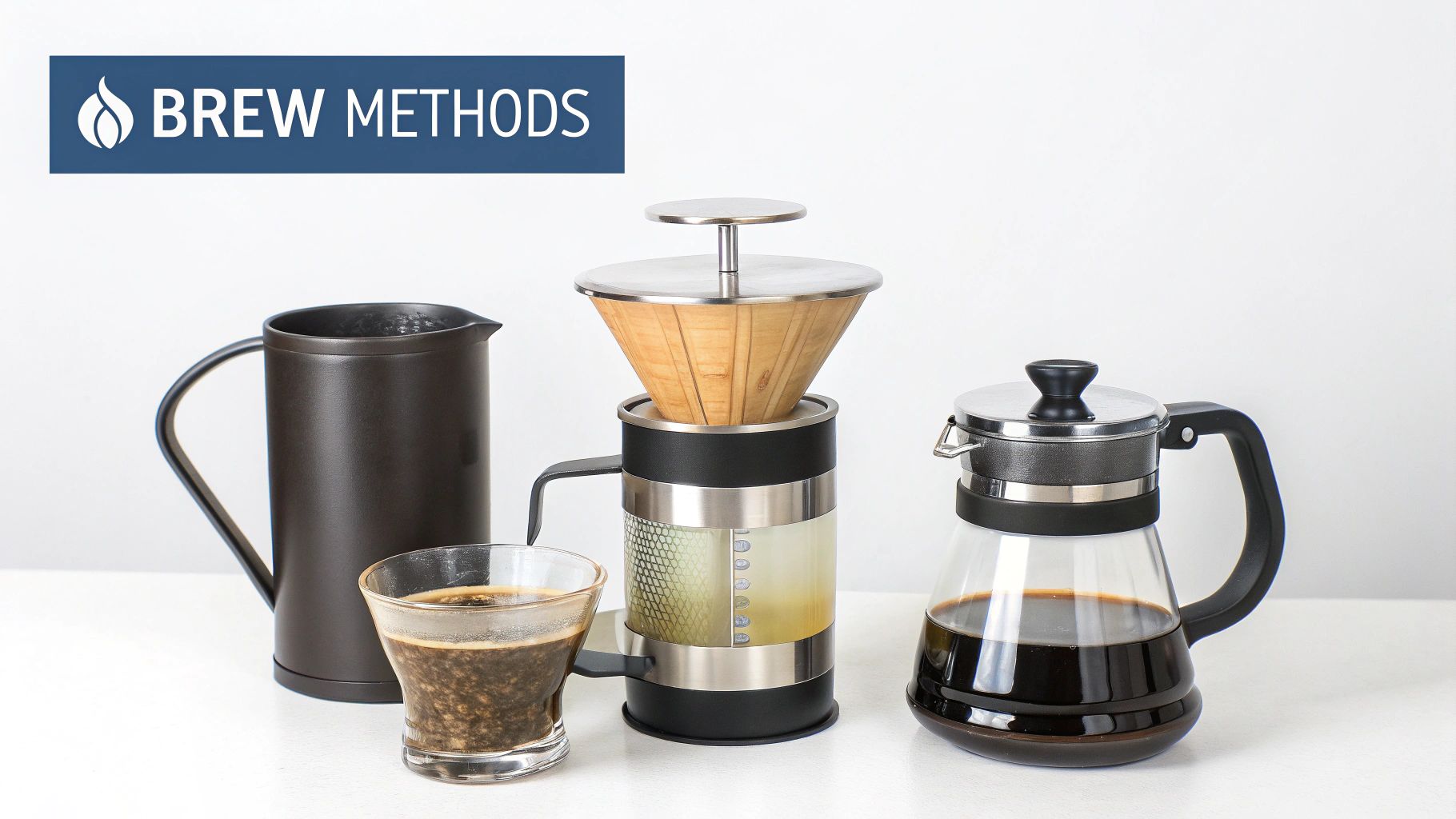
Now that we’ve covered the science of extraction, let’s bring it back to the gear on your kitchen counter. Every brewing device, from a simple drip machine to a fancy espresso maker, has its own personality. Each one interacts with coffee grounds differently, creating unique risks for bitterness. Your job is to get to know your brewer and tweak your technique to match.
Think of it like cooking. A thin stainless steel skillet heats up in a flash and needs you to stay on your toes to avoid burning your food. A heavy cast-iron pan, on the other hand, retains heat and cooks more evenly. Neither is “bad,” but they demand different approaches. Same deal with your coffee maker.
Drip Coffee Makers and Pour-Over
Drip machines and pour-over setups are all about percolation, which is just a fancy way of saying water passes through the coffee grounds. This style gives you a ton of control, but it also comes with its own set of challenges. The main reason you’ll get bitter coffee here usually boils down to flow and time.
If your grind is too fine, it can clog the filter and slow the water down to a crawl. That extended contact time is a classic recipe for over-extraction. But if you go too coarse, water gushes right through, leaving you with a weak, disappointingly sour cup.
Quick Fixes for Drip and Pour-Over:
- Check Your Grind: You’re aiming for something that looks and feels like table salt. If your coffee’s bitter, try adjusting just one step coarser.
- Time Your Brew: For a pour-over, a good target is a total brew time of 2.5 to 4 minutes. If it’s dragging on longer than that, your grind is almost certainly too fine.
- Get Everything Wet: Make sure all the grounds are evenly saturated right at the start. Any dry pockets will lead to uneven extraction—some grounds give up too much flavor while others give up too little.
French Press Immersion Brewing
The French press is an immersion brewer. The coffee grounds steep directly in the water for the entire brew, kind of like tea. This method is incredibly forgiving and makes a wonderfully full-bodied cup, but it has one major weakness: it’s super easy to let it sit too long.
Since the grounds are always in contact with the water, there’s no escaping extraction. Steeping for just an extra minute or two can send the bitterness through the roof. And that plunger? It doesn’t actually stop the process, it just separates the big grounds from the liquid. For a deeper dive, check out our complete guide on how to make French press coffee and really nail the technique.
The number one mistake with a French press is not pouring the coffee out immediately after plunging. That fine sludge at the bottom will keep on extracting, making the last sip from the carafe intensely bitter. Always pour all the coffee into mugs or a separate server right away.
Espresso Machines and Intense Pressure
Espresso is a different beast entirely. It uses a ton of pressure to force hot water through a tightly packed puck of finely ground coffee in a very short amount of time. Because the process is so intense, even tiny mistakes get magnified, often resulting in a powerfully bitter shot.
The classic cause of a bitter espresso is a shot that runs for too long. A balanced, delicious shot should typically extract in 25-30 seconds. If you let it run for 40 seconds or more, you're just pulling out all those harsh, bitter compounds you don't want. This usually happens when the grind is too fine, which chokes the machine and slows everything down.
The Role of Coffee Beans and Roast Level
While your brewing technique is a massive piece of the puzzle, you can't ignore the raw material. The coffee bean itself plays a starring role in the final flavor, and not all bitterness is created equal. Understanding your beans and their roast level is key to controlling the kind of bitterness that ends up in your cup.
Think of it like chocolate. A rich, 75% cacao dark chocolate has a complex, intentional bitterness that’s deeply satisfying. On the other hand, a burnt, low-quality chocolate bar just tastes harsh and unpleasant. Coffee works the same way; some bitterness is a desirable flavor note, while other types are a sign something went wrong.
Dark Roasts and Desirable Bitterness
It’s a common belief that dark roasts are inherently more bitter, and there’s truth to that. The longer a coffee bean is roasted, the more its natural sugars caramelize and eventually break down. This process creates different flavor compounds, including phenols, which contribute to that classic, bold bitterness.
But a skillfully executed dark roast isn't about tasting burnt. It's about developing deep, robust flavors of dark chocolate, toasted nuts, and smoky sweetness. The bitterness in a great dark roast provides structure and balance, creating a satisfying, full-bodied experience. It’s the difference between a perfectly seared steak and one that’s been left on the grill too long.
The Impact of Roast Quality
The real issue often isn't the roast level, but the quality of the roast and the beans themselves. Historically, some large-scale roasters used dark roasting to hide the flaws of low-quality, inconsistently sourced beans. Because the beans are exposed to higher temperatures for longer, dark roasts inherently produce more bitter-tasting compounds while breaking down acids and sugars. In the mid-20th century, this became an easy way to simplify mass production, leading many to associate dark roasts with the burnt, oily beans on supermarket shelves. You can find out more about how these historical trends shaped the coffee market by exploring USDA coffee production insights.
A quality dark roast should taste bold and rich, never ashy or acrid. If your dark roast coffee tastes bitter in a harsh, unpleasant way, it might be due to over-roasting or poor-quality green coffee rather than the roast style itself.
Choosing a roaster who focuses on sourcing high-quality beans is crucial. When you start with excellent raw ingredients, the roaster can develop complex flavors without needing to scorch away imperfections. To learn more about what to look for, our guide on how to select fresh roasted coffee beans can help you make a more informed choice.
Ultimately, your preference matters most. If you dislike the deep, smoky notes of a French or Italian roast, a light or medium roast might be a better fit. These roasts preserve more of the bean's original acidity and delicate floral or fruity notes. Experimenting with different beans and roast levels will help you discover which flavor profiles you enjoy, allowing you to distinguish between intentional complexity and the unwelcome bitterness that ruins a cup.
Your Step-by-Step Troubleshooting Checklist
When your coffee tastes bitter, it can feel like a personal failure. But figuring out what went wrong is a lot simpler than you think. By methodically checking a few core brewing variables, one by one, you can zero in on the culprit and make the right adjustments. This checklist will turn you into a coffee detective, starting with the most likely suspects first.
Think of it like tuning a guitar. You don’t crank on every peg at once; you adjust one string at a time until you find the right note. We'll take that same focused approach to get your brew back in harmony.
Start with Your Grind Size
The first and most impactful variable to check is your grind size. An incorrect grind is behind the vast majority of bitter coffee cups because it directly controls how long water is in contact with the grounds and how quickly flavors are extracted.
- Is it too fine? A grind that looks like powder or fine sand creates a massive amount of surface area, causing the water to pull out those harsh, bitter compounds way too quickly. This is often the number one reason your coffee tastes bitter.
- The Fix: Adjust your grinder to a coarser setting. Just one or two clicks can make a huge difference. For a French press, you’re looking for a texture similar to coarse sea salt. For a standard drip machine, aim for something closer to regular table salt.
Remember, consistency is everything. A quality burr grinder is your best friend here because it produces uniform particles, which is absolutely essential for an even, balanced extraction. Blade grinders, on the other hand, create a chaotic mix of dust and boulders, making bitterness almost unavoidable.
Evaluate Brew Time and Water Temperature
If tweaking the grind didn't solve the problem, your next move is to look at time and temperature. These two elements work hand-in-hand to determine the final extraction level.
-
Check Your Brew Time: How long are the grounds and water actually interacting? For a pour-over, this is the total time from the first pour to the final drip. For a French press, it’s how long you let it steep before plunging. A brew that runs too long will inevitably start pulling out those unpleasant bitter flavors. Try shortening it by 15-30 seconds.
-
Measure Your Water Temperature: Water that’s too hot—especially anything above 205°F (96°C)—will scorch the grounds and aggressively yank out bitter compounds. An easy fix is to let your kettle rest for about a minute after it boils. This will bring it down into that ideal 195-205°F sweet spot.
This infographic can help you visualize how your initial bean choice influences the final cup profile.
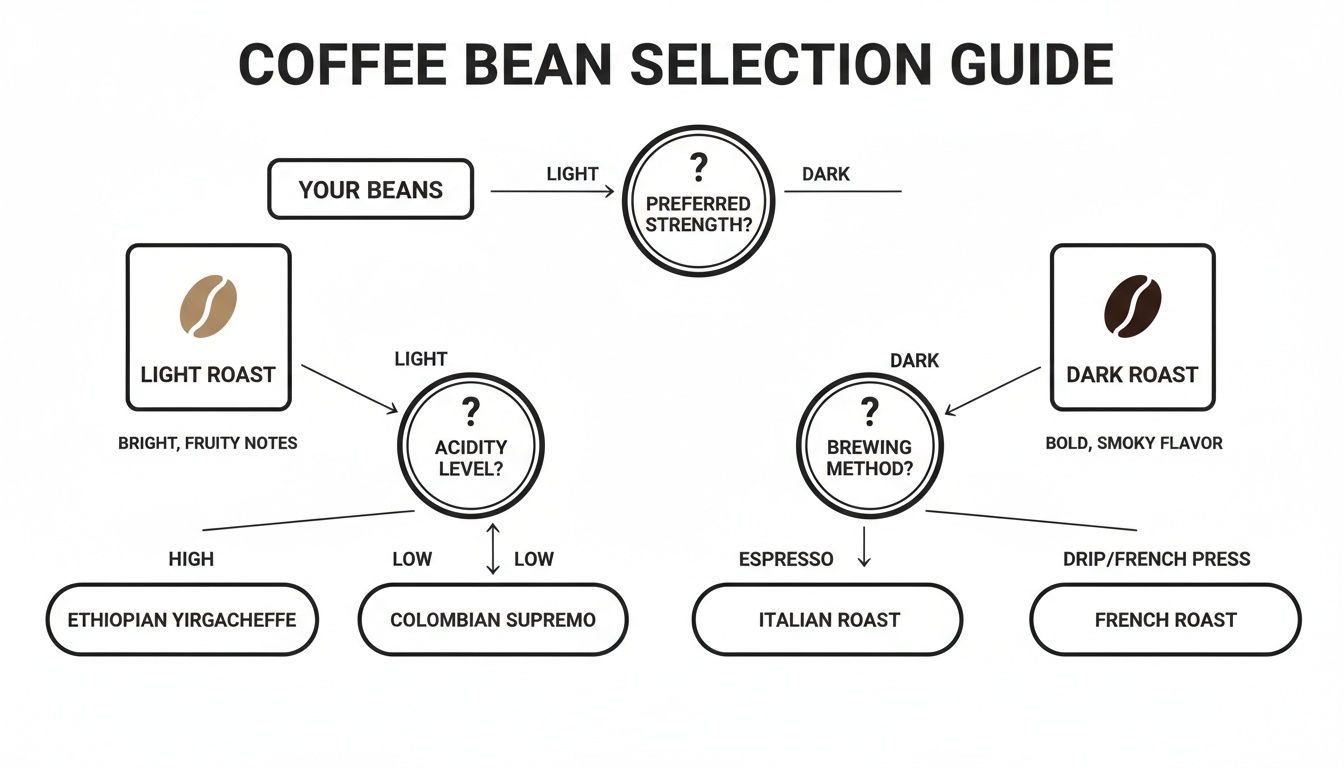
As the decision tree shows, both light and dark roasts can produce a fantastic cup of coffee, but they require different brewing strategies to keep bitterness at bay.
Final Check on Your Ratio and Beans
Finally, if that bitterness is still hanging around, it's time to look at your coffee-to-water ratio and the coffee itself. Using too much coffee for the amount of water can sometimes lead to a crowded brew bed where the water can't flow evenly, causing pockets of over-extraction.
Your beans might also be the issue, especially if you're working with instant coffee. Luckily, that doesn't mean you're doomed to a bad cup. You can learn how to make instant coffee taste better with just a few small tweaks. By following this checklist, you can systematically knock out each potential cause until you land on that perfect, balanced brew.
Still Have Questions About Bitter Coffee?
Even when you think you've got it all figured out, a few nagging questions about bitterness can pop up. Let's clear the air on some of the most common ones so you can fine-tune your way to the perfect brew.
Is Dark Roast Coffee Always Bitter?
Not a chance. A great dark roast should be bold and balanced, not burnt and bitter. Think of the satisfying, deep bitterness you get from a high-quality piece of dark chocolate—it's complex and rewarding, not harsh.
The nasty, ashy bitterness most people associate with dark roasts is usually a red flag for low-quality beans. Some industrial roasters will burn their coffee to a crisp just to hide all the defects in cheap beans. A true, well-crafted dark roast, however, has a rich, deep flavor where that bitterness provides a pleasant, robust foundation instead of being the main event.
Can My Water Make My Coffee Taste Bitter?
It absolutely can. Your final cup is over 98% water, so what’s in it matters—a lot. Water that's too "hard," loaded with minerals like calcium, can get a little too aggressive during brewing. It latches onto coffee compounds and rips them out, leading to over-extraction and a harsh, almost chalky bitterness.
On the flip side, using distilled or super "soft" water creates another problem. It doesn't have enough mineral content to properly extract the good stuff, leaving you with a cup that’s flat, weak, and totally forgettable. The sweet spot is always filtered water; it has just enough of the right minerals to do the job well.
Think of your water's minerals like tiny magnets for flavor. Too many magnets (hard water) pull out everything, including the bitter stuff. Too few (soft water) can't grab onto enough flavor, leaving your coffee hollow. Filtered water gives you the perfect magnetic pull for a balanced brew.
How Do I Make My Coffee Pods Less Bitter?
That bitter kick from a single-serve coffee pod is a dead giveaway for over-extraction. It happens when the machine forces too much water through a tiny amount of coffee grounds. Long after all the good, sweet flavors have been washed away, the machine is still pushing water through, pulling out nothing but the bitter dregs left behind.
Thankfully, the fix is incredibly simple: just pick a smaller cup size on your machine. Instead of going for the 8 or 10-ounce setting, give the 6-ounce option a try. You'll get a more concentrated, properly extracted shot of coffee that isn’t watered-down and bitter.
Does a Dirty Coffee Maker Actually Cause Bitterness?
Yes, and it's one of the most common culprits people overlook. Day after day, old coffee oils and tiny grounds build up inside every part of your machine, from the carafe to the hidden internal tubes. These old residues eventually go stale and rancid.
Then, when you brew a fresh pot, that hot water picks up all those gross, foul-tasting deposits and mixes them right into your new coffee. The result? A stale, bitter flavor that has nothing to do with your beans. A quick rinse after every use and a deep clean or descaling session once a month will keep your gear from ruining your brew.
Ready to brew a better cup without all the guesswork? Lost Without Coffee Co. sources and roasts incredible beans made for adventure, from bright medium roasts to rich, satisfying dark roasts. Find your new favorite and finally say goodbye to bitter coffee at https://www.lostwithoutcoffee.com.