

The Difference Between Arabica and Robusta Coffee Explained
If you've ever wondered what the real difference is between Arabica and Robusta, it boils down to this: Arabica beans bring a nuanced, aromatic, and sweeter flavor, making them the star of the specialty coffee world. On the flip side, Robusta beans pack a bold, strong, and often bitter punch with nearly double the caffeine, which is why they're the go-to for powerful espresso blends and instant coffee.
Arabica vs. Robusta: A Quick Comparison
When you’re staring at a wall of coffee bags, labels like "100% Arabica" or "Robusta Blend" can feel a little intimidating. These aren't just marketing terms; they represent the two dominant coffee species grown around the globe, each with its own personality shaped by genetics, geography, and ultimately, taste.
Getting a handle on the differences is the first step toward finding the perfect brew for any situation—whether that’s a quiet morning with a pour-over or a high-octane fuel-up before hitting the trail.
Historically, Arabica has been the crowd favorite, making up about 60% of the world's coffee production, while Robusta accounts for the other 40%. This split tells a story about where and how they grow. Arabica is the high-maintenance one, thriving at high altitudes between 2,000-6,000 feet where the air is cool. Think of the premium coffee regions of Ethiopia and Guatemala. Robusta, true to its name, is far more rugged. It's happy at lower elevations and can handle hotter, harsher conditions, which is why its production is booming in places like Vietnam. If you want to dive deeper, you can learn more about global coffee production insights.
Key Differences Between Arabica and Robusta
To make things simple, here’s a quick-glance table breaking down the core distinctions between these two coffee giants. It’s a handy cheat sheet for understanding what's really in your cup.
| Characteristic | Arabica | Robusta |
|---|---|---|
| Taste Profile | Sweet, fruity, floral, with bright acidity. | Bold, earthy, chocolatey, with a bitter finish. |
| Caffeine Content | Lower (Avg. 1.5% by weight). | Higher (Avg. 2.5% or more by weight). |
| Bean Shape | Oval, elongated with a curved center slit. | Round, smaller with a straight center slit. |
| Growing Conditions | High altitudes, cool temperatures, ample rain. | Low altitudes, hot climates, more resilient. |
| Common Uses | Specialty coffee, pour-overs, single-origin brews. | Espresso blends, instant coffee, high-caffeine drinks. |
| Market Price | Generally higher due to delicate growing needs. | Generally lower due to higher yields and hardiness. |
So, next time you're choosing your beans, this little bit of knowledge will go a long way. Are you in the mood for something delicate and aromatic, or do you need a powerful, straightforward kick? The answer will lead you straight to the right bag.
Understanding the Origins and Botany of Coffee
To really get what separates Arabica from Robusta, we need to go back to their roots. Literally. These aren't just slightly different types of coffee; they are entirely distinct species, each one shaped by where it first grew. Their stories start on opposite sides of the African continent, which explains a lot about the plants we cultivate today.
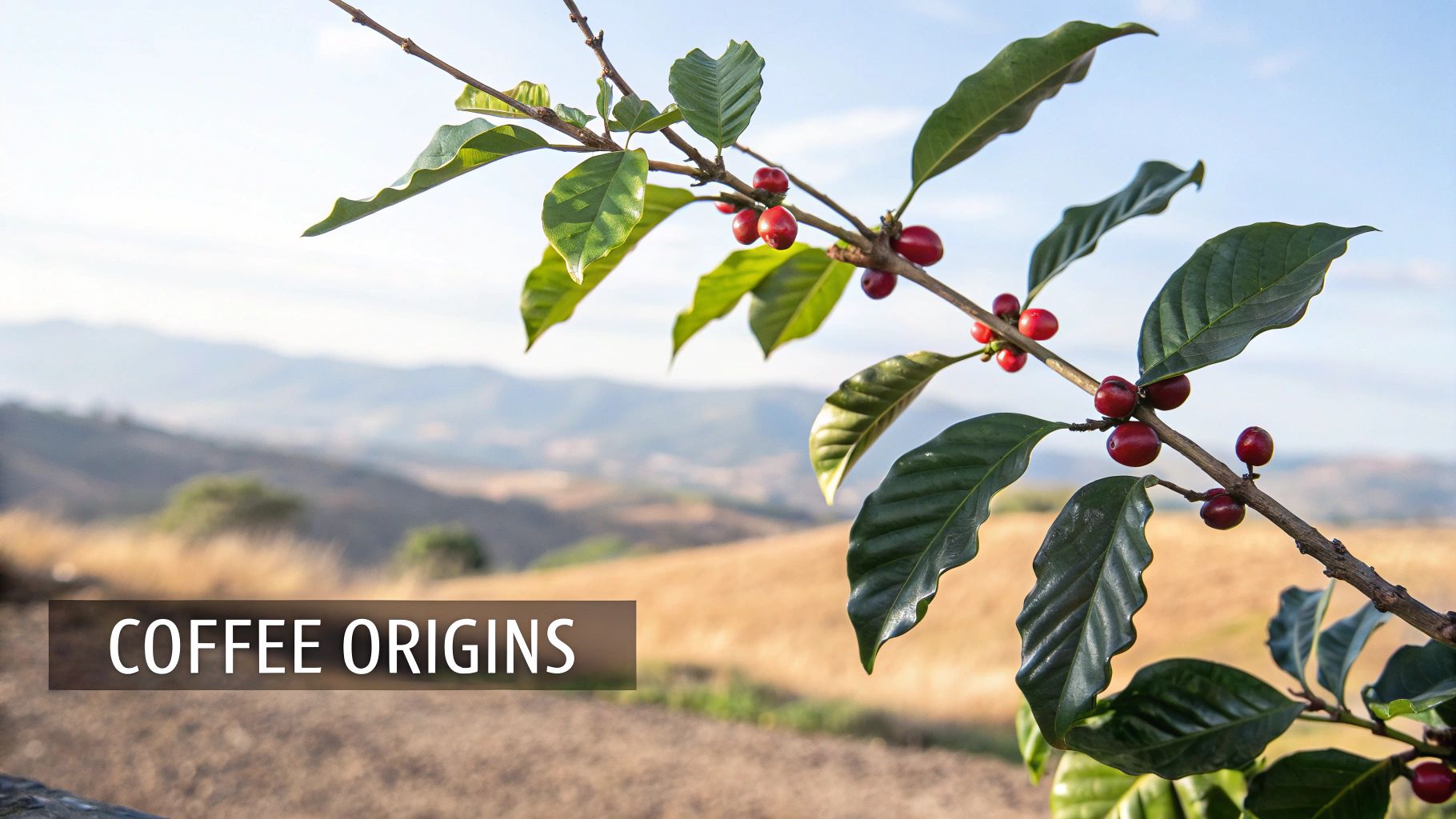
The story of specialty coffee almost always begins with Arabica (Coffea arabica). It first appeared in the cool, misty highlands of southwestern Ethiopia, growing wild under the canopy of ancient forests. That single fact still dictates its picky growing conditions to this day.
On the flip side, you have Robusta (Coffea canephora), which comes from the hot, humid lowland forests of sub-Saharan Africa. Just like its name suggests, Robusta is a tough, resilient plant built to handle way harsher climates and tougher conditions than its high-altitude cousin.
The Genetic Blueprint
From a botanical perspective, one of the biggest differences is hidden in their DNA. Arabica is a tetraploid plant, meaning it has four sets of chromosomes. This genetic complexity is a huge reason it can produce such nuanced, aromatic, and layered flavors.
Robusta, however, is a diploid plant with only two sets of chromosomes. This simpler genetic code is directly linked to its more straightforward, bold, and powerful taste.
Another key botanical difference is how they make more coffee plants. Arabica plants are typically self-pollinating, meaning they can fertilize themselves. This leads to less genetic variation and more consistent traits within specific varietals—a quality that’s highly prized in specialty coffee. To see how this affects coffee from a single farm or region, you can learn more about what single-origin coffee is in our detailed guide.
Robusta plants need cross-pollination, meaning they require pollen from a different plant to produce cherries. This process creates a ton of genetic diversity, making Robusta incredibly adaptable but also much less uniform than Arabica.
Physical Plant Characteristics
Even just looking at the plants and their unroasted beans, the differences are obvious.
- Arabica Plants: These are smaller shrubs, usually growing to about 6-15 feet tall. Their leaves are a deep, vibrant green, and the green coffee beans are distinctly oval-shaped with a curvy center slit.
- Robusta Plants: These are much larger, more like trees, and can tower up to 30 feet or more. Their leaves are broader, and the unroasted beans are smaller, rounder, and have a straight slit down the middle.
Key Takeaway: The physical differences aren't just for looks. The denser, oval Arabica bean is packed with more oils and sugars, which caramelize during roasting to create those complex aromas and flavors we love. The round Robusta bean has fewer of those, but it packs way more caffeine.
Environmental Needs and Adaptations
These botanical traits translate into completely different needs on the farm. Arabica is famously fussy and difficult to grow, demanding very specific conditions to even survive, let alone produce quality coffee.
Arabica's Ideal Environment:
- Altitude: It has to be grown at high elevations, typically between 3,000 and 6,000 feet.
- Temperature: It needs cool, stable temperatures, ideally between 60-75°F (15-24°C).
- Rainfall: Requires consistent, plentiful rain.
- Vulnerability: It's extremely susceptible to pests and diseases like coffee leaf rust.
This pickiness is why you only find Arabica grown in very specific regions along the "Bean Belt," mostly in Latin America, Eastern Africa, and parts of Asia.
In stark contrast, Robusta is a farmer's best friend. Its natural resilience makes it far easier and cheaper to grow, which is a big reason for its lower price on the market.
Robusta's Resilient Nature:
- Altitude: It loves hot, humid climates at lower elevations, from sea level up to 2,500 feet.
- Temperature: It can handle much warmer weather, often thriving above 75°F (24°C).
- Yield: It produces way more coffee cherries per plant.
- Hardiness: It's naturally resistant to most pests and diseases, partly because its high caffeine content acts as a natural pesticide.
Understanding where these plants came from and what makes them tick is the first step to appreciating why your morning pour-over and your pre-workout espresso taste, feel, and hit so differently. The whole journey from a wild African plant to the cup in your hand is defined by these fundamental genetic and environmental roots.
Decoding the Flavor and Aroma Profiles
The quickest way to really get the difference between Arabica and Robusta is to just taste them side-by-side. When you lift a cup of coffee to your lips, the flavor and aroma tell a story that starts deep inside the bean's chemistry. These two coffee species offer profoundly different experiences, all thanks to their unique mix of sugars, lipids, acids, and other organic compounds.
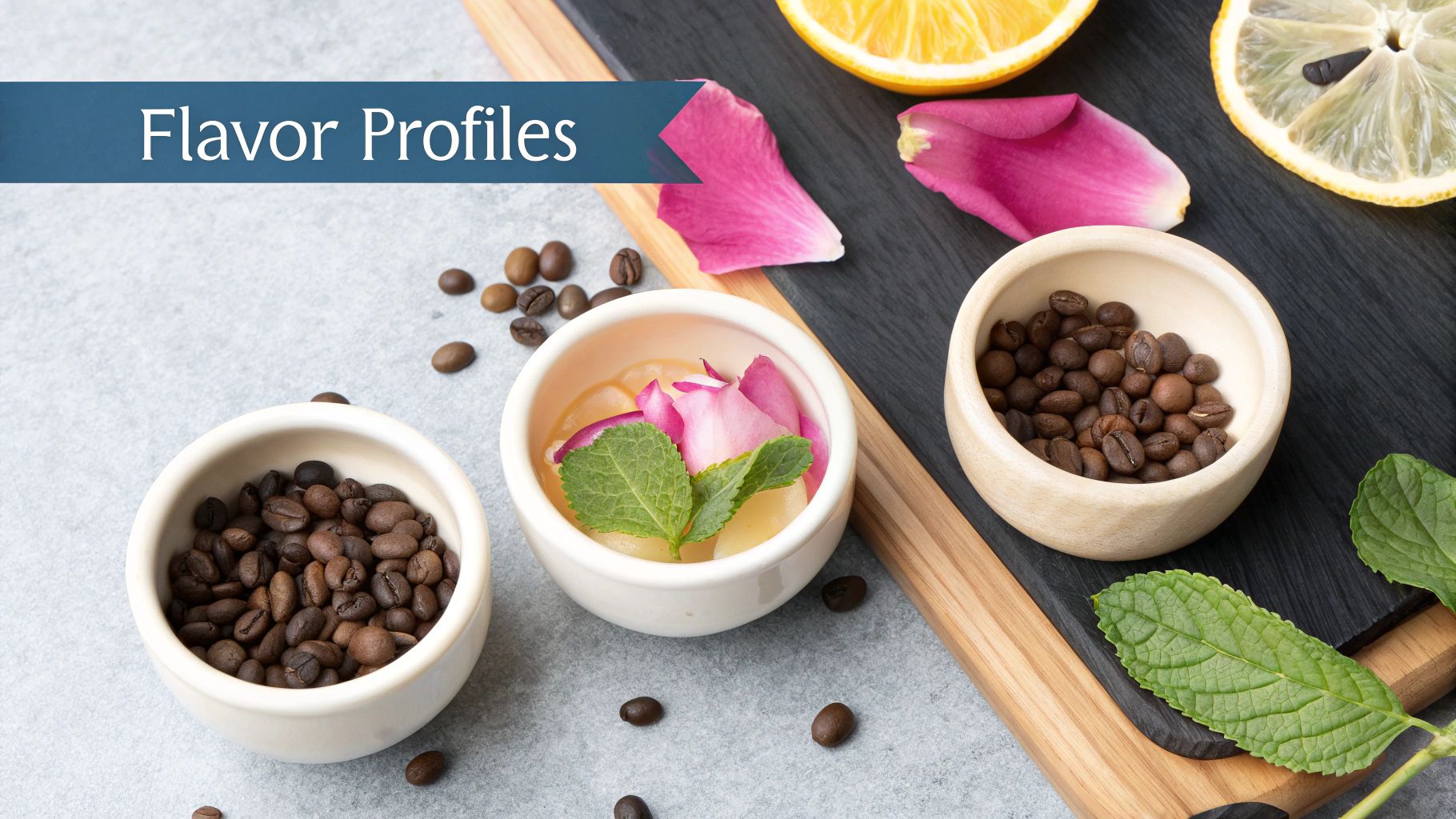
Tasting a great Arabica is like exploring a delicate, layered landscape of flavor. Its profile is defined by a bright, vibrant acidity that can feel like a crisp citrus tang or a soft, wine-like quality. That acidity is beautifully balanced by a natural sweetness, which comes from its higher concentration of sugars—nearly double that of Robusta.
The Nuanced World of Arabica
Arabica beans are packed with lipids (oils), which create a smoother, softer mouthfeel and carry its famously complex aromas. During roasting, these sugars and lipids get to work, creating a symphony of delicate tasting notes.
- Fruity Notes: Think bright berries, sweet stone fruits like peach, or the tangy zip of lemon and bergamot.
- Floral Aromas: High-quality Arabicas often have delicate scents of jasmine, honeysuckle, or rose.
- Sweet Undertones: You’ll frequently find notes of caramel, honey, or milk chocolate that lead to a pleasant, clean finish.
This intricate flavor profile is exactly why Arabica runs the specialty coffee market. It’s the go-to bean for brewing methods like pour-over or drip that are designed to showcase its subtle complexities. To see just how varied it can be, you can dive into the unique Ethiopian coffee flavor profile.
The Bold Character of Robusta
If Arabica is a delicate landscape, Robusta is a force of nature. Its flavor is direct, intense, and unapologetically bold. This punch comes from its lower sugar content and different chemical makeup, resulting in a taste often described as strong and earthy.
Robusta's signature bitterness isn't a flaw—it's a feature. It comes from higher levels of caffeine and chlorogenic acids. Those same compounds are responsible for its rich, thick crema, the velvety reddish-brown foam that sits atop a perfect shot of espresso.
While Robusta lacks the bright acidity of Arabica, it makes up for it with a full, heavy body and a powerful kick. Its flavor profile isn't about subtlety; it's all about depth and richness.
- Earthy and Woody Tones: Common notes include dark chocolate, toasted nuts, and a distinctive rubbery or woody character.
- Bitter Finish: That pleasant bitterness is a hallmark of Robusta, providing a strong, lasting taste.
- Rich Crema: Its ability to produce a stable, thick crema makes it an essential part of many traditional Italian espresso blends.
A Sensory Side-by-Side Comparison
To truly wrap your head around the differences, it helps to see their sensory traits compared directly. This chart breaks down what you can expect in the cup.
| Sensory Attribute | Arabica Coffee | Robusta Coffee |
|---|---|---|
| Acidity | High and bright (citrus, winey) | Low and smooth |
| Sweetness | High (fruit, sugar, caramel) | Low (often masked by bitterness) |
| Bitterness | Low to moderate | High and pronounced |
| Body/Mouthfeel | Light to medium, smooth and soft | Full and heavy, sometimes viscous |
| Aroma | Complex and aromatic (floral, fruity) | Strong and direct (earthy, nutty) |
| Aftertaste | Clean and pleasant | Bold and lingering, sometimes rubbery |
Ultimately, choosing between them comes down to what you like and how you're brewing. An Arabica offers a journey of discovery in every sip, perfect for a quiet moment of appreciation. A Robusta, or a blend containing it, delivers a potent, satisfying, and straightforward coffee experience—ideal for a strong start to the day or as the base for a milky drink. Knowing these profiles helps you pick the beans that will give you exactly the coffee you're craving.
The Kick: A Tale of Two Caffeine Levels
Beyond flavor and origin, the real heavy-hitter difference between Arabica and Robusta is the kick. It’s not just a small detail; the caffeine gap fundamentally changes why and when you’d reach for one over the other. It’s the reason one cup is a gentle nudge and the other is a full-on jolt.
On average, Robusta packs nearly twice the caffeine punch of Arabica. A typical Robusta bean is about 2.5% caffeine by weight (or even higher), while its Arabica cousin sits around a milder 1.5%. This isn’t a coincidence—it’s a key part of Robusta's survival strategy.
Caffeine is a natural pesticide. Robusta's high concentration helps protect the plant from pests and diseases, which is a major reason it can thrive in harsher, lower-altitude environments where threats are more common.
This built-in defense mechanism translates directly to the cup, delivering a much more potent brew. It makes Robusta the go-to choice for those moments when you need a high-octane boost, not just a casual coffee break.
How Caffeine Shapes Your Coffee Experience
That higher caffeine content in Robusta does more than just wake you up; it’s a huge player in the coffee’s taste. Caffeine on its own has a distinctly bitter flavor, which is a big contributor to Robusta’s characteristically bold, sometimes harsh finish. This bitterness gets a boost from another set of compounds: chlorogenic acids (CGAs).
Robusta beans have a lot more CGAs than Arabica. While these antioxidants have some health benefits, they also add to a sharp, bitter taste once they're roasted. It's this one-two punch of high caffeine and high CGA levels that gives Robusta its powerful, punchy, and less acidic profile.
This chemistry has some very practical applications for your daily grind:
- For a Pre-Workout Boost: A shot of espresso with a healthy dose of Robusta can deliver that quick, intense energy you need to power through a workout.
- For an Intense Morning Start: When you really need to shake off the cobwebs and get going, a Robusta blend provides an immediate and lasting lift.
- For Long Hauls: Drivers or students pulling an all-nighter often rely on Robusta-heavy blends for their potent stimulant effects.
Global Production and Practical Choices
Robusta's hardiness isn't just a fun botanical fact; it's reshaping the global coffee map. In Brazil, the world's top coffee producer, climate shifts are making it tougher to grow the delicate Arabica plant. Because of this, Robusta production has surged by over 81% in the last decade, with its 4.8% yearly gains easily outpacing Arabica's growth. Farmers are turning to these productive varietals for better profitability. You can read more about this climate-driven shift in Brazilian coffee farming on fortune.com.
So, what does this all mean for you? The choice really comes down to what you need from your coffee.
- Choose Arabica when you want a smooth, all-day sipper where complex flavors are the main event. Its lower caffeine content is perfect for enjoying multiple cups without getting the jitters. Lost Without Coffee’s single-origin roasts are perfect for this.
- Choose a Robusta blend when you need maximum function and a powerful kick. It’s the engine behind a strong espresso, giving you that rich crema and an undeniable energy boost that holds up beautifully to milk and sugar.
How Growing Conditions Influence Market Price
The price gap you see on the shelf isn't just clever marketing; it’s a direct story of what it takes to get each coffee plant from seed to cup. The journey from the farm to your wallet is shaped by everything from altitude and climate to the plant's own resilience, creating a real value difference between the two species.
Understanding these agricultural realities makes it clear why one bean almost always commands a premium over the other.
Arabica is, to put it mildly, a bit of a diva. It needs a very specific set of conditions that sound more like a five-star mountain retreat than a farm: high altitudes, just the right amount of rain, and mild, steady temperatures. This agricultural pickiness seriously limits where it can be grown, making it a boutique crop compared to the tough-as-nails Robusta.
This sensitivity also makes Arabica farms incredibly vulnerable. One unexpected frost, a long drought, or an outbreak of coffee leaf rust can wipe out an entire year's harvest. That high risk, combined with lower yields per plant, means farmers put in more time, labor, and resources for a much less predictable return—and that drives up the cost.
The Hardy Nature of Robusta
In total contrast, Robusta absolutely lives up to its name. It’s a tough, resilient plant that thrives in conditions that would decimate an Arabica crop. It loves hotter climates and lower altitudes, which opens up huge areas of the planet for its cultivation.
Robusta plants are also naturally more resistant to pests and diseases, partly because their higher caffeine content acts as a built-in bug repellent. This hardiness, plus a much higher yield of coffee cherries per plant, makes it a far more reliable and cost-effective crop for farmers to grow.
The core economic difference boils down to this: Arabica is a high-risk, high-reward specialty crop, while Robusta is a high-volume, lower-risk commodity. This is the main driver behind the price gap you see in the market.
This economic reality plays out on a global scale. Arabica's 60-70% market share is built on its superior quality and delicate taste, flourishing in ideal climates like Colombia's Eje Cafetero. Robusta, on the other hand, shows its tropical grit in places like Vietnam and Indonesia. The U.S. specialty coffee market, which hit US$51.33 billion in 2023, is dominated by Arabica, but roasters often blend in a little Robusta to achieve a specific flavor profile or a killer crema. You can dive deeper into these market dynamics in the latest ICO coffee report.
Comparing Agricultural Demands
To really put their needs in perspective, let's look at their ideal growing environments side-by-side. The differences aren't subtle—they define the entire supply chain.
| Agricultural Factor | Arabica Requirements | Robusta Requirements |
|---|---|---|
| Ideal Altitude | 3,000 - 6,000 feet (900 - 1,800 meters) | Sea level - 2,500 feet (0 - 760 meters) |
| Optimal Temperature | Cool & mild: 60-75°F (15-24°C) | Hot & humid: 75-85°F (24-30°C) |
| Annual Rainfall | 1,500 - 2,500 mm, needs a distinct dry season | 2,000 - 3,000 mm, tolerates irregular patterns |
| Disease Resistance | Highly susceptible to pests & coffee leaf rust | Naturally resistant to most common diseases |
| Yield Per Plant | Lower | Significantly higher |
These factors create a clear economic divide. The limited land suitable for high-quality Arabica, combined with its fragility, means supply is tighter and more precarious. Robusta's adaptability allows for massive-scale farming, ensuring a steady, abundant supply that keeps its price down.
Ultimately, when you buy a bag of high-grade, single-origin Arabica, you're not just paying for a delicate flavor. You’re investing in the incredibly challenging agricultural work, the higher risk shouldered by farmers, and the very specific geography capable of producing such a nuanced bean. It’s an appreciation for the true value behind every single cup.
Choosing the Right Bean for Your Brew Method
Knowing the difference between Arabica and Robusta is one thing, but translating that knowledge into a truly great cup of coffee? That comes down to matching the bean to the brew method. This is where the rubber meets the road. Your choice of brewer can either highlight a bean's delicate, nuanced flavors or crank up its bold, intense character.
Take a quiet morning with a pour-over, for example. It’s the perfect stage for a high-quality Arabica. The slow, methodical extraction of a V60 or Chemex coaxes out all those complex floral and fruity notes you find in a great light-roast. The paper filter catches the oils, leaving you with a clean, crisp cup that lets the bright acidity and subtle sweetness sing.
But when you need a fast, powerful kick to start the day, an espresso machine or a Moka pot is your best friend. These methods use pressure to force out a concentrated, punchy brew, making them the ideal partners for a blend that includes Robusta. That Robusta is what gives you the signature thick crema, a deep, resonant body, and an undeniable caffeine jolt that an all-Arabica shot often can't match.
Matching Beans to Brewing Styles
The relationship here is symbiotic—the bean and the brewer work together. Some methods are just naturally built to bring out the best in certain coffees. The AeroPress, a fan favorite for its incredible versatility, is a great example. You can use it to press a clean, almost tea-like cup from an Arabica or a strong, espresso-style shot from a Robusta blend, all by tweaking your technique.
Then you have the French press. Its full-immersion style and metal filter produce a rich, full-bodied cup with a lot more texture. This method is fantastic for both, but it’s especially forgiving with a medium or dark roast Arabica, pulling out those deep chocolate and nutty notes. It can also help smooth out some of Robusta's rougher edges while keeping all of its satisfyingly heavy body.
This simple flowchart is a great place to start when pairing your brew method with the right bean.
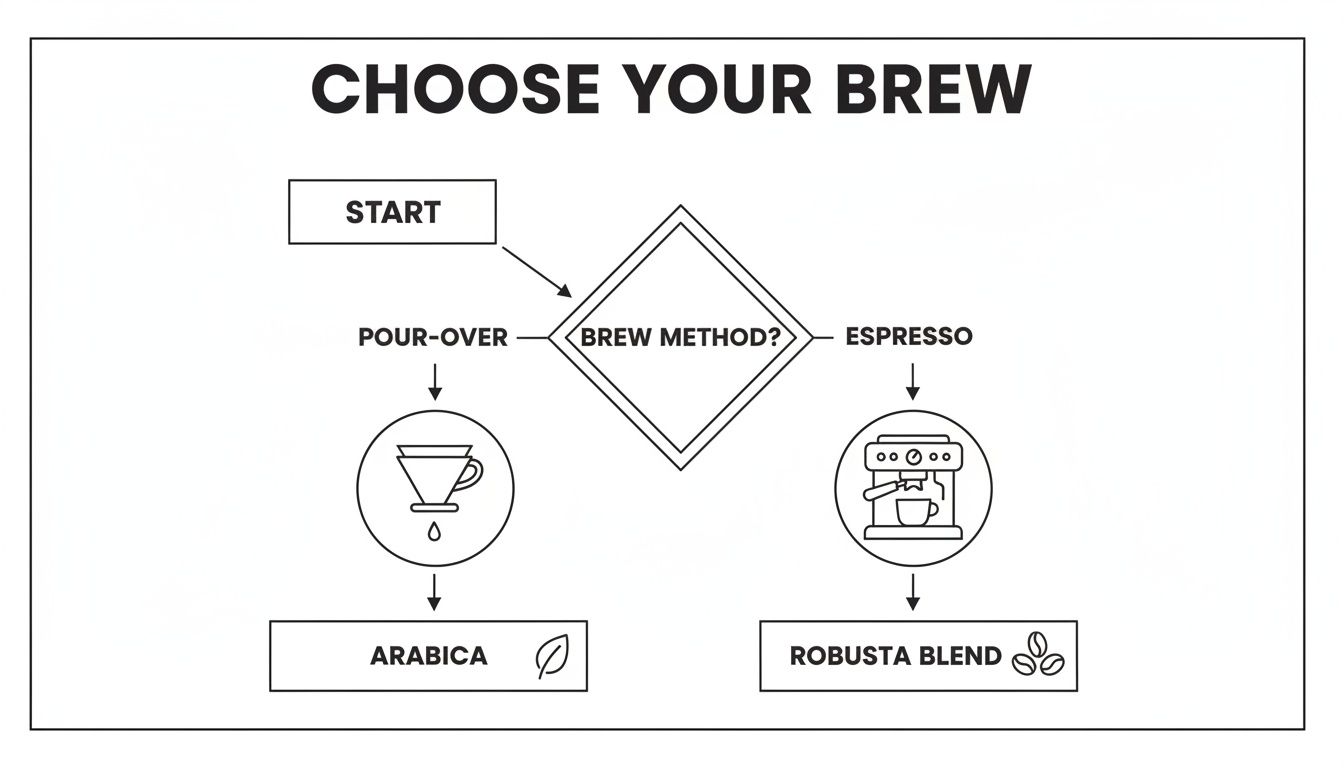
As the chart shows, methods that emphasize clarity and nuance are an Arabica's best friend. Those built for intensity and body are perfect for bringing out the best in Robusta blends.
Practical Scenarios and Recommendations
Let's put this into action. Your coffee choice isn't just about your gear; it's about your mood and what you need from your coffee right now.
-
For the Outdoor Adventurer: When you're out on the trail, convenience and potency are everything. A quality instant coffee—often with a Robusta component for that quick, powerful jolt—is a lifesaver. Lost Without Coffee's instant options were literally made for this, giving you a serious boost without any fuss.
-
For the Coffee Connoisseur: If you love the ritual of brewing, a single-origin Arabica from a place like Ethiopia or Guatemala is where you want to be. Grab your pour-over or siphon and take your time extracting all those delicate, complex flavors. Our light and medium roast Arabica beans are perfect for this mindful process.
-
For the Espresso Enthusiast: If you're chasing that classic, rich espresso shot with a thick, velvety crema that just won't quit, a blend is almost always the answer. Just a small amount of high-quality Robusta (10-15%) adds the body, bitterness, and crema that pure Arabica just can't deliver on its own.
Key Insight: Stop thinking of it as Arabica being "good" and Robusta "bad." Think of them as different tools for different jobs. The best coffee is the one that’s brewed well and is the perfect fit for the moment you’re in.
Ultimately, understanding the strengths of Arabica and Robusta gives you the power to brew the perfect cup, every single time. For an even deeper dive into finding the right beans, check out our guide on how to choose coffee beans. By lining up your beans with your brewer, you make sure every sip is exactly what you were hoping for.
A Few More Questions
Even after a deep dive, the world of coffee always leaves a few more beans to turn over. Let's tackle some of the most common questions about Arabica and Robusta to clear things up.
Is Arabica Always Better Than Robusta?
Not at all. "Better" is completely in the eye of the beholder—it all comes down to what you're looking for in your cup.
If you're after delicate aromas, a kaleidoscope of complex flavors, and a silky-smooth finish, a high-quality Arabica is the undisputed king. It’s perfect for a thoughtful pour-over or a gentle morning brew where nuance is the goal.
But a well-grown Robusta can easily blow a low-grade Arabica out of the water. Robusta’s superpower is its punch. It delivers a serious caffeine kick, a thick and lasting crema for espresso, and a bold body that isn't afraid of a little milk and sugar. In fact, many world-class espresso blends intentionally include a small percentage of quality Robusta to perfect their texture and intensity.
The Verdict: Think of them as different tools for different jobs. Arabica is your go-to for aromatic elegance and complexity. Robusta is the undisputed champ for a powerful body and a serious caffeine boost.
How Can I Tell if My Coffee Is Arabica or Robusta?
The easiest way is to just check the bag. A good specialty roaster is proud of their beans and will almost always tell you what you're buying—often with extra details on origin, altitude, and tasting notes. A bag labeled "100% Arabica" makes it pretty clear.
If the packaging is a mystery, let your taste buds be the judge.
- Arabica tends to be smoother and sweeter, with a bright acidity that might remind you of fruit or wine.
- Robusta is bolder, more bitter, and often has a powerful, earthy or even rubbery aftertaste.
You can also tell by looking at the unroasted beans. Raw Arabica beans are larger and distinctly oval, while Robusta beans are smaller and more circular.
Which Bean Is More Sustainable to Farm?
That's a tough one, because both come with their own sustainability challenges and wins. Arabica is famously fussy—it's vulnerable to climate change and diseases like coffee leaf rust. It demands specific high-altitude conditions, and as the planet warms, suitable farmland is shrinking, putting pressure on fragile ecosystems.
On the flip side, the specialty Arabica market has been a huge force for good, pushing sustainable practices like shade-growing (which boosts biodiversity) and direct trade relationships that put more money in farmers' pockets.
Robusta is the hardier of the two. Its natural resistance to disease and its ability to thrive in warmer climates make it a more reliable and climate-resilient crop for many farmers. The most sustainable choice isn't really about picking a species—it's about supporting roasters who care about traceability, ethical sourcing, and fair partnerships with farmers, whether they're growing Arabica or Robusta.
Ready to find your perfect brew? Whether you're chasing the nuanced flavors of a single-origin Arabica or the powerful kick of a carefully crafted blend, Lost Without Coffee Co. has you covered. Explore our collection of fresh-roasted beans, convenient pods, and trail-ready instant coffee. Find your perfect adventure fuel at https://www.lostwithoutcoffee.com.