

Finding the Best Portable Coffee Maker for Travel
A great portable coffee maker should deliver a fantastic cup of coffee without weighing down your pack. But the best one for you? That really comes down to where you're headed. An ultralight manual brewer is a backpacker's best friend, while a zippy electric model might be perfect for your next road trip.
This guide will help you sort through the options and find the perfect travel companion for your adventures.
Your Guide to Great Coffee Anywhere You Go
Let's be honest, the world of portable coffee makers can be a bit much. But it doesn't have to be confusing. The secret is matching the brewer to your travel style. Think of it like packing shoes: you wouldn't wear hiking boots to the beach or flip-flops on a mountain trail, right? The same logic applies here.
The ideal brewer for a thru-hike is totally different from what you’d pack for a hotel stay or a car camping trip. We're here to cut through the noise and help you pick the right gear with confidence. For a deeper dive into campsite brewing, check out our guide to making great coffee for camping.
Which Travel Coffee Maker Fits Your Style?
To get started, it helps to see the main options at a glance. Are you counting every single ounce for a backpacking trip, or is convenience your top priority for the family RV? Knowing whether you'll have access to power or if you're going completely off-grid will immediately narrow down your choices.
The goal here is simple: spend less time digging through reviews and more time sipping incredible coffee, no matter where you wake up.
Travel Coffee Maker Quick Guide
Use this comparison to find the portable coffee maker type that best matches your adventure.
| Brew Style | Best For | Typical Weight | Heat Source Needed |
|---|---|---|---|
| Manual Press | Backpacking, All-Around Use | 4-12 oz (110-340g) | External (Stove/Kettle) |
| Pour-Over | Car Camping, Detailed Brewing | 5-15 oz (140-425g) | External (Stove/Kettle) |
| Portable Espresso | Road Trips, Hotel Stays | 1-2 lbs (450-900g) | External or Battery |
| Electric Brewer | RVs, Van Life, Hotels | 2-4 lbs (900-1800g) | Battery or Outlet |
As you can see, what you gain in convenience with electric models, you trade for in weight. For those of us heading into the backcountry, a lightweight manual press or pour-over is almost always the way to go.
Manual vs. Electric Travel Coffee Makers
When you're picking out a portable coffee maker, it really boils down to one big question: manual or electric? The best way to think about it is like driving a car. Manual brewers are your "stick shift"—they put you in complete control, are incredibly reliable when you're off the grid, and tend to be much lighter. Electric brewers are the "automatic," giving you that sweet push-button convenience but tethering you to a power source.
Each one is built for a different kind of adventurer. This decision tree can help you visualize which coffee maker best fits your adventure, from a rugged backpacking trip to a comfortable hotel stay.
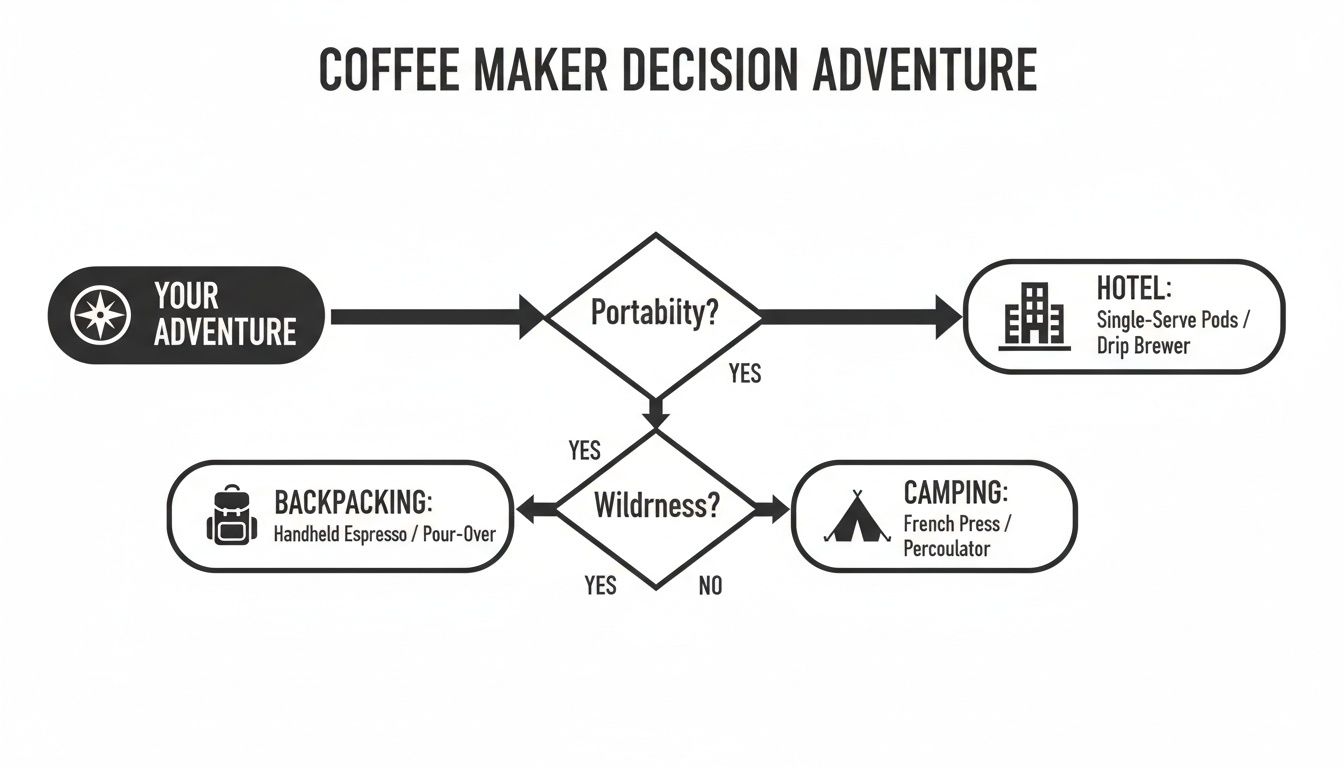
As the flowchart shows, if you're a minimalist traveler or a backpacker, a manual brewer is a no-brainer. But if you’ve got access to power, like in a hotel or a well-equipped campsite, an electric model is a fantastic luxury.
Manual Brewers: The Hands-On Approach
Manual coffee makers are the undisputed champions of simplicity and rock-solid reliability. They're perfect for rugged conditions and for anyone who has to carry their life on their back.
- No electronic parts to fail.
- Lighter and more compact.
- Total control over your brew.
- Requires separate hot water source (stove/kettle).
The trade-off is the hands-on effort. For many coffee lovers, though, this is exactly the point. For more ideas, check out our guide to the best coffee makers for camping.
Electric Brewers: Convenience at Your Fingertips
Electric portable coffee makers are all about getting a consistent cup with the least amount of fuss. These gadgets can heat the water and brew your coffee with a single button press.
- Push-button simplicity.
- Heats its own water (on many models).
- Consistent results every time.
- Requires power (battery or outlet).
This hunger for convenience has fueled some serious growth. The global portable coffee makers market was valued at around USD 5.45 billion and is projected to climb to USD 9.94 billion by 2033. The fact that battery-operated models are the fastest-growing segment tells you everything you need to know: these have gone from niche gear to mainstream travel essentials.
Head-to-Head Comparison: Manual vs. Electric
This table gives you a quick, no-nonsense breakdown of how manual and electric brewers stack up.
| Feature | Manual Brewers | Electric Brewers |
|---|---|---|
| Power Needs | ❌ None (needs external heat) | ✅ Requires battery or outlet |
| Weight | ⚖️ Super light (4–15 oz) | ⚖️⚖️ Heavier (1–4 lbs) |
| Durability | 💪 High (fewer breakable parts) | 💪 Moderate (sensitive electronics) |
| Best For | 🏕️ Backpacking, Off-Grid | 🚐 Road Trips, Hotels, RVs |
| Brew Control | 🔧 Total Control | 🤖 Automated |
Ultimately, both styles can make a fantastic cup of coffee on the go. The "better" option is simply the one that slots perfectly into your travel plans and your personal coffee philosophy.
Key Features to Look for Before You Buy
Picking the right portable coffee maker means focusing on five key features. Think of each feature as a trade-off: what you gain in one area, you might give up in another. This quick look will help you find the brewer that actually fits your style of adventure.
| Feature | What to Look For | Why It Matters |
|---|---|---|
| 1. Weight & Packability | Low weight (under 1 lb for backpacking) and a compact, packable shape. | Every ounce counts on the trail. Bulky items take up precious pack space. |
| 2. Durability & Materials | BPA-free plastics, stainless steel, or flexible silicone. | Your gear will get bumped and dropped. The right material ensures it survives the trip. |
| 3. Heat Source | External (stove), Self-Heating (battery), or No Heat (cold brew). | This determines where you can use it. Off-grid vs. near a power source. |
| 4. Brew Quality | Method matches your taste (e.g., Press, Pour-Over, Espresso). | Different methods extract different flavors. Choose the one that makes coffee you love. |
| 5. Ease of Cleaning | Simple designs with few parts that are easy to rinse and wipe clean. | Complicated cleanup is a hassle, especially when water is limited. |
Digging Deeper into the Features
Weight & Packability: For backpackers, a difference of 4-6 ounces feels significant after a few miles. Manual brewers (AeroPress, pour-overs) are clear winners here. Electric models with batteries are better suited for car camping.
Durability & Materials:
- BPA-Free Plastics: Lightweight and tough (e.g., AeroPress).
- Stainless Steel: Heavier but indestructible and retains heat.
- Silicone: Ultra-light and collapsible for maximum space-saving.
Heat Source & Power Needs: This is the main factor that splits brewers into two camps. Your choice here will instantly narrow down your search.
| Heat Source Type | How It Works | Best For |
|---|---|---|
| External Heat | You boil water separately with a camp stove, fire, or kettle. | Backpacking, camping, minimalist travel. |
| Self-Heating | An internal, battery-powered element heats the water for you. | Road trips, van life, hotels. |
| No Heat (Cold Brew) | Some brewers are designed for making cold brew without heat. | Hot climates, long-term travel. |
Brew Quality & Method: A portable espresso maker gives you rich, concentrated shots. A pour-over highlights bright, delicate notes. The versatile AeroPress Go Coffee Maker is legendary for its ability to brew anything from an espresso-like concentrate to a clean, full-bodied cup.
Ease of Cleaning: The last thing you want is a complicated cleanup. Look for simple designs. The AeroPress, for example, self-cleans by pushing grounds out in a neat puck, requiring just a quick wipe.
How to Brew Perfect Coffee Outdoors
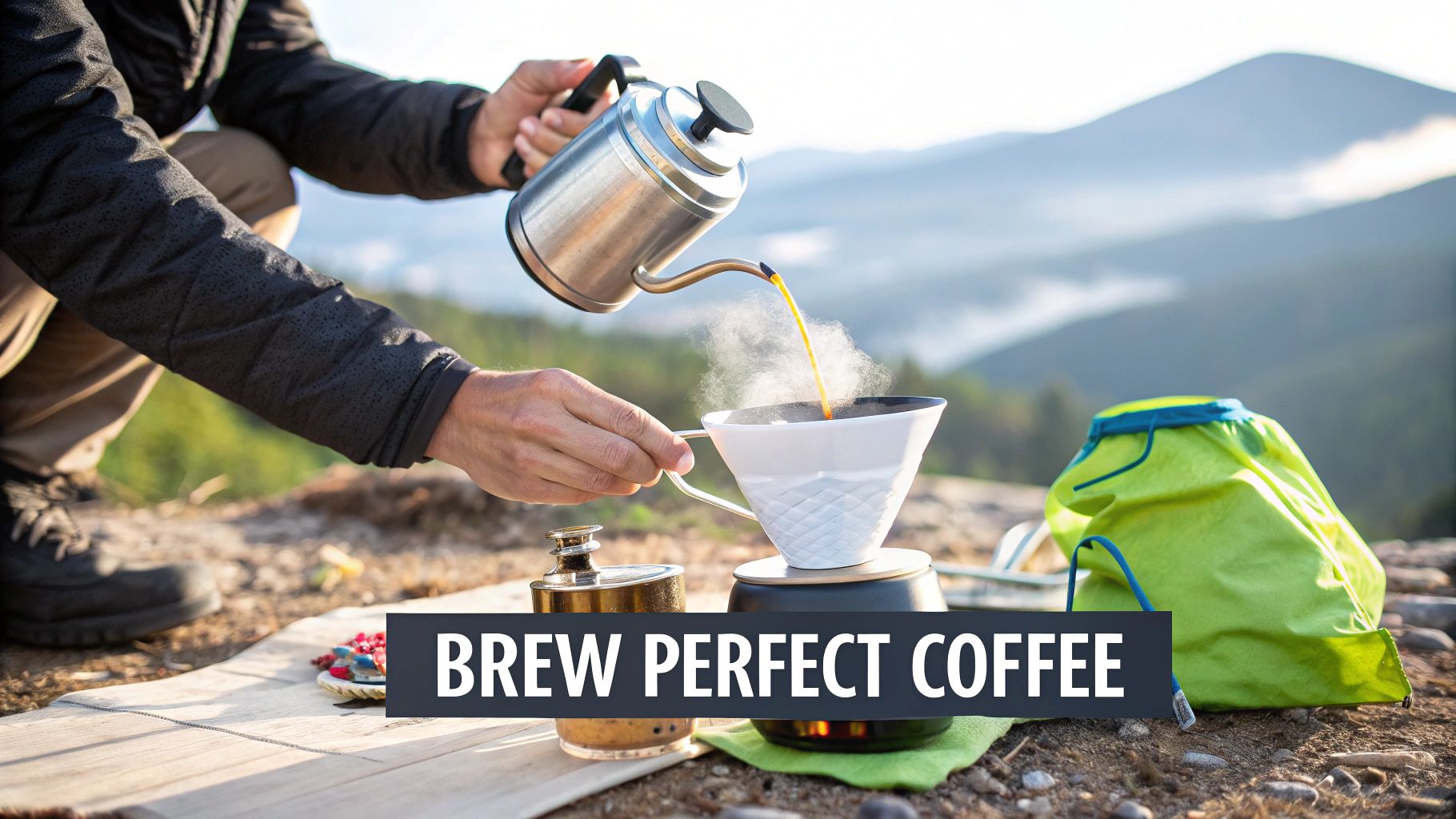
Having the right portable coffee maker is a great start, but it's only half the battle. Nailing a few simple techniques guarantees an amazing cup, no matter where you are. The demand for great coffee on the go is booming—the outdoor portable coffee machine market was valued at around USD 500 million and is expected to grow by 8% annually through 2033. You can discover more about this expanding market.
Master the Golden Ratio
The foundation of any great cup is the coffee-to-water ratio. A fantastic starting point is roughly 1 gram of coffee for every 15 to 18 grams of water.
Easy Measurement Guide
1 Tablespoon Coffee ➔ 4 Ounces Water
Pro Tip: Bringing a scale is impractical. Pre-measure single servings of coffee at home into small, reusable bags to save time and guesswork on the trail.
Get the Grind Size Right
Grind size is everything. It dictates flavor extraction. The key is matching the grind to your brewer.
| Grind Size | Looks Like | Best For |
|---|---|---|
| Coarse | Coarse sea salt | French Press, Percolator |
| Medium | Gritty sand | Drip Coffee, Pour-Over |
| Fine | Table salt | AeroPress, Moka Pot |
Freshly ground beans are best, but pre-ground coffee is a great lightweight option. Just grind it for your specific brewer before you leave home.
Perfect Your Brew with Lost Without Coffee Co
Here are two go-to recipes for brewing our coffees in the wild.
1. For the AeroPress User (Guatemala Antigua) Our Guatemala Antigua's chocolate and almond notes shine with this balanced brew.
- Grind: Medium-fine (table salt)
- Ratio: 1 part coffee to 15 parts water (17g coffee to 255g water)
- Technique: Use the inverted method. Steep for 90 seconds, then press gently for 30 seconds for a rich, full-bodied cup.
2. For the Pour-Over Enthusiast (Ethiopia Guji) This bean’s bright, fruity notes are perfect for the clean profile of a pour-over.
- Grind: Medium (sand)
- Ratio: 1 part coffee to 16 parts water (20g coffee to 320g water)
- Technique: Pour hot water slowly in circles for a total brew time of around 3 minutes.
These are just starting points. The best part of brewing outdoors is the freedom to experiment.
Building Your Ultimate Travel Coffee Kit
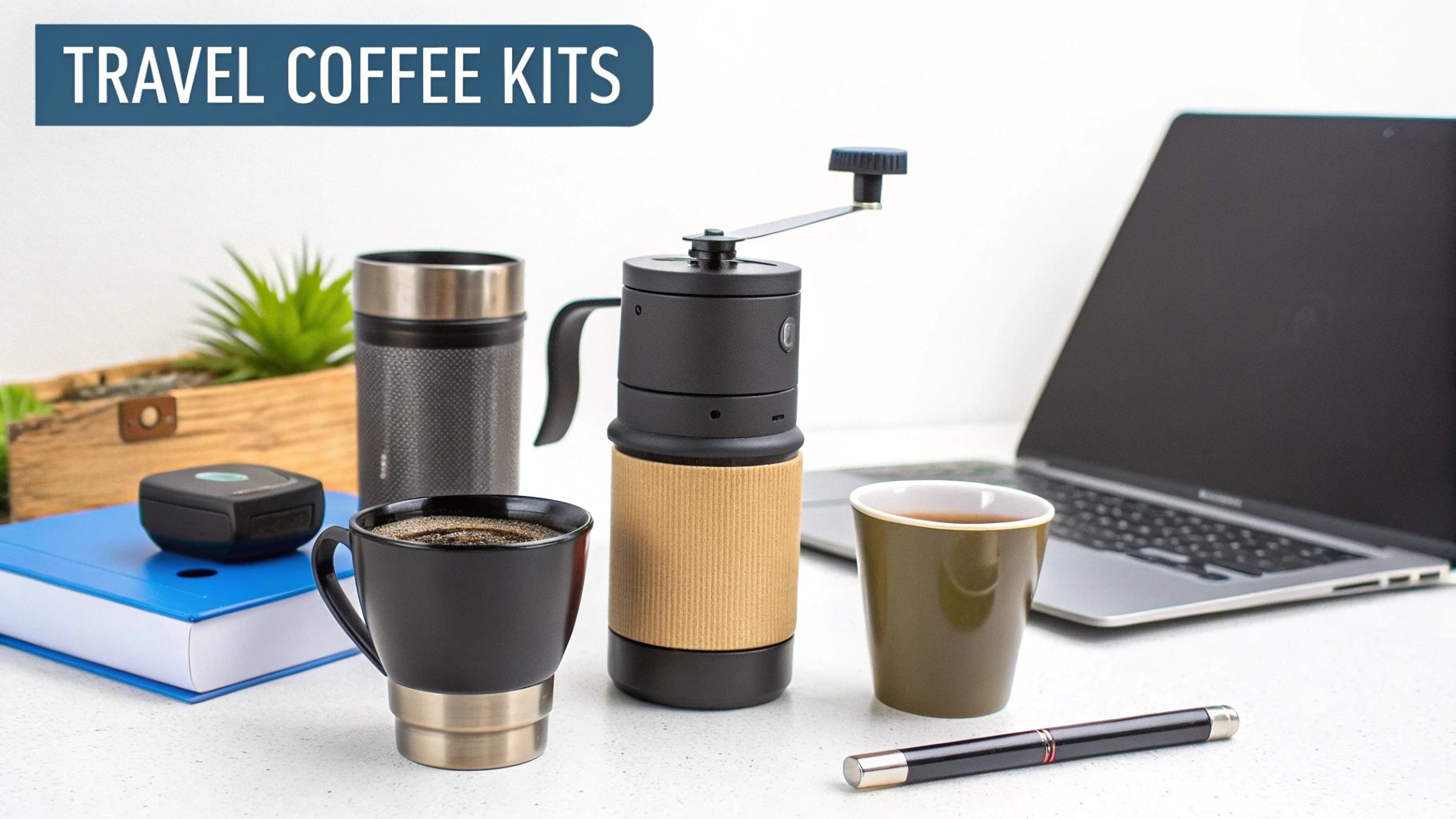
A great cup on the road is about the whole system. We’ve put together three complete kits designed for different adventurers. Think of them as pre-packed loadouts for your next journey.
Kit 1: The Ultralight Hiker
Goal: Maximum flavor, minimum weight.
- Brewer: Pour-over dripper or AeroPress Go.
- Coffee: Instant Coffee packs (lightest) or pre-ground packs.
- Mug: Single-wall titanium mug (ultralight, can heat water).
Kit 2: The Car Camping Connoisseur
Goal: Full café experience at the campsite. It's no surprise that outdoor lovers are serious about coffee. The portable espresso machine market alone was valued at USD 149.29 million and is projected to nearly double by 2034. You can explore more data on this booming market.
- Brewer: Manual portable espresso maker.
- Grinder: Compact hand-crank burr grinder.
- Coffee: Ethiopia Guji whole beans.
- Mug: Double-walled insulated mug.
Kit 3: The Digital Nomad
Goal: Speed, convenience, and consistency.
- Brewer: Compact pod-compatible machine (battery or plug-in).
- Coffee: Single-serve Coffee Pods (no mess).
- Mug: Spill-proof travel mug.
Still Have Questions? Let's Clear Things Up
Here are answers to the most common questions about portable coffee makers.
What's the easiest brewer to clean while camping?
The AeroPress. Its plunger design squeegees the chamber and ejects grounds as a dry puck. A quick rinse is all it takes. Silicone pour-over drippers are a close second.
Can I bring my coffee maker in my carry-on?
Yes. Manual brewers are fine. For electric models with a lithium-ion battery, you are required to pack them in your carry-on, not checked baggage. Ensure it's clean and dry.
How do I get hot water for coffee when I'm off-grid?
A compact backpacking stove is your best bet. A Jetboil or MSR PocketRocket boils water in minutes. A thermos filled at home works for day trips.
Off-Grid Water Heating Options
| Method | Best For | Speed | Notes |
|---|---|---|---|
| Backpacking Stove | Hiking, Backpacking | Wicked Fast (2-3 mins) | The most reliable and efficient choice. |
| Campfire | Car Camping | Pretty Slow (10-15 mins) | Requires a fire-safe pot. |
| Insulated Thermos | Day Trips, Road Trips | Instant | You have to heat the water ahead of time. |
Do I really need a special grinder for travel?
While pre-ground is convenient, a portable manual hand grinder is the single biggest upgrade you can make to your travel coffee game. Freshly ground beans deliver unbeatable flavor. Look for a compact model with durable ceramic or stainless steel burrs for a consistent grind.
Ready to piece together your perfect travel coffee kit? Check out our full collection of adventure-ready coffees and brewers at Lost Without Coffee Co. and stop settling for mediocre coffee on the road. Find your next favorite brew right here: https://www.lostwithoutcoffee.com.